
Personality assessments can be useful.
DISC, Big Five, Myers-Briggs, and similar tools can help leaders understand communication styles, behavioral preferences, and how people may approach work.
But personality does not tell leaders whether someone is likely to stay.
That is the gap.
An employee may have the right personality profile, perform well, and still become a retention risk because the role no longer fits, the manager relationship weakens, values feel misaligned, growth stalls, or hidden team friction builds beneath the surface.
The future of retention is not personality. It is alignment.
Leaders need to understand whether employees are still aligned with the role, manager, team, company values, and future they see inside the business.
This guide explains why personality tests are limited for retention, why alignment is a stronger signal, and how leaders can use better visibility to detect retention risk before strong employees leave.
Table of Contents
Key Takeaways
| Point | Details |
|---|---|
| Personality is not enough | Personality tools can explain style, but they do not fully reveal retention risk. |
| Alignment predicts staying | Employees are more likely to stay when the role, manager, team, and company environment still fit. |
| Fit changes over time | A strong hire can become misaligned as work, leadership, team dynamics, or expectations shift. |
| Hidden friction creates risk | Manager friction, values disconnect, and team tension can build before performance drops. |
| OpenElevator adds visibility | OpenElevator helps leaders see retention risk, values alignment, interpersonal alignment, and hidden team friction earlier. |
Why Personality Tests Fall Short for Retention
Personality tests became popular because they make people easier to understand.
They give leaders language for communication style, behavioral tendencies, decision-making preferences, and collaboration patterns. That can help with hiring, onboarding, coaching, and team conversations.
But retention depends on more than personality.
Personality assessments usually describe the person. They do not fully describe the relationship between the person and the work environment.
That relationship is where retention risk forms.
Personality tests may not reveal:
| What They Miss | Why It Matters |
|---|---|
| Manager-employee alignment | A strong employee can disengage if trust, feedback, or expectations weaken. |
| Values alignment | Employees may leave when the company environment no longer fits what matters to them. |
| Team friction | Personality data may explain differences, but not whether those differences are creating hidden tension. |
| Growth clarity | Strong employees may leave if they cannot see a future inside the company. |
| Workload sustainability | Burnout can build quietly before performance drops. |
| Recognition | Employees may disengage when their contribution feels invisible. |
| Role fit over time | A role that fit at hiring may stop fitting as responsibilities change. |
The problem is not the personality test.
The problem is using it as a retention strategy.
A personality profile may tell leaders how someone tends to operate. It does not tell them whether the employee still feels aligned, supported, connected, and likely to stay.
What Really Predicts Retention: The Power of Alignment
Retention improves when leaders understand alignment.
Alignment means the employee still fits the role, manager, team, company values, and future path available inside the business.
This is more useful than personality alone because alignment can strengthen or weaken over time.
An employee may start highly engaged and later become a retention risk if the manager changes, workload increases, growth stalls, or team friction grows.
Leaders should pay attention to these alignment areas:
| Alignment Area | Retention Question |
|---|---|
| Role alignment | Does the work still fit the employee’s strengths, motivation, and expectations? |
| Manager alignment | Does the employee feel supported, understood, and clear on expectations? |
| Values alignment | Does the company environment still fit what matters to the employee? |
| Team alignment | Does the employee feel connected to the people they work with? |
| Growth alignment | Does the employee see a future inside the company? |
| Workload alignment | Is the workload sustainable enough for the employee to keep contributing well? |
| Recognition alignment | Does the employee feel their contribution is seen and valued? |
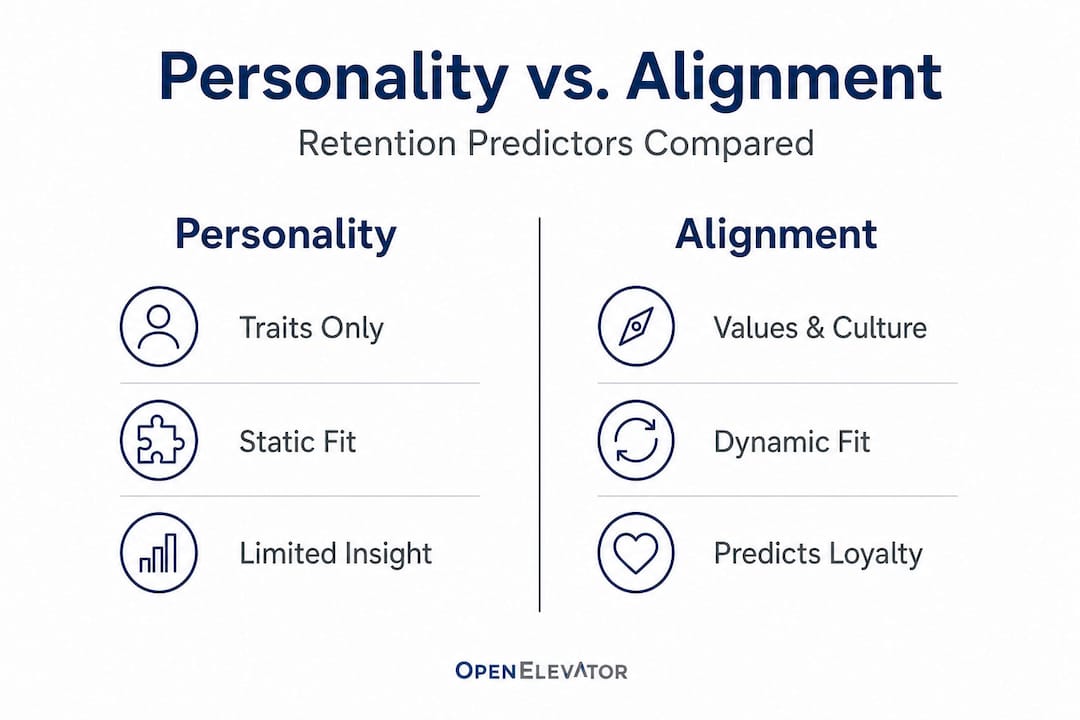
This is where many companies miss risk.
They know an employee’s personality type, but they do not know whether that employee is still aligned with the experience they are having every day.
The better retention question is not:
“What type of person is this?”
The better question is:
“Is this person still aligned with the role, manager, team, and company?”

Building a Culture of Alignment
Building alignment is not a one-time workshop.
It is an ongoing leadership practice.
Leaders need to keep checking whether the employee experience matches what people need to stay engaged and committed. That means looking beyond hiring fit and paying attention to what happens after the employee joins.
Use this framework:
| Step | What to Do | Why It Matters |
|---|---|---|
| 1. Define what alignment means | Clarify the values, work expectations, manager behaviors, and team norms that matter. | Leaders cannot measure alignment if they have not defined it. |
| 2. Look for gaps between stated values and lived experience | Ask whether employees actually experience the culture leaders describe. | Values disconnect creates retention risk. |
| 3. Review manager-employee alignment | Look at trust, feedback, clarity, recognition, and support. | The manager relationship strongly affects whether employees stay. |
| 4. Watch team dynamics | Pay attention to hidden friction, weak connection, and unresolved tension. | Team friction can weaken commitment before performance drops. |
| 5. Revisit alignment over time | Check whether fit is strengthening or weakening as roles, teams, and priorities change. | Fit is dynamic, not fixed. |
| 6. Act on what you find | Match the intervention to the real issue. | Generic retention programs miss specific alignment problems. |
Alignment is not about forcing employees to fit the company.
It is about understanding whether the relationship between the employee and the company still works.
When it does not, leaders need to see the risk early enough to act.
Measuring and Sustaining Alignment
Alignment needs to be measured repeatedly because employee experience changes.
A person may be aligned at hiring and misaligned six months later. A new manager, heavier workload, unclear expectations, team tension, or stalled growth can change the employee’s level of commitment.
Annual engagement surveys are usually too slow to catch that shift.
Leaders need earlier visibility into signals such as:
| Signal | What It May Reveal |
|---|---|
| Lower participation | The employee may be pulling back from the team. |
| Shorter communication | The relationship may be becoming more transactional. |
| Less interest in growth | The employee may no longer see a future inside the company. |
| Weaker manager connection | Manager alignment may be declining. |
| Reduced initiative | The employee may feel less ownership or motivation. |
| More visible frustration | Workload, values misalignment, or team friction may be creating risk. |
| Declining team connection | Belonging or interpersonal alignment may be weakening. |
These signals do not prove someone will leave.
They show where leaders should look more closely.
The goal is not surveillance. The goal is visibility.
Leaders need enough information to ask better questions before resignation becomes the first clear signal.
Why True Retention Requires a Shift in Mindset
Many leaders are more comfortable measuring personality than measuring alignment.
Personality feels safer because it describes the individual. Alignment is harder because it may reveal problems in the environment: weak manager relationships, unclear expectations, values gaps, team tension, or leadership trust issues.
That is why alignment work requires more courage.
It asks leaders to look at what the company may be creating, not only who the employee is.
This is where most retention strategies stay too shallow.
They ask:
“Did we hire the right type of person?”
They should also ask:
“Are we creating the conditions where the right people can stay?”
A person can be a strong hire and still leave if the environment stops working for them.
A team can look stable while values misalignment, manager friction, or hidden tension is already forming.
A company can have low turnover today while retention risk is quietly building underneath.
The future of retention belongs to leaders who can see alignment risk earlier and act before avoidable turnover becomes expensive.
How OpenElevator Helps Leaders See Alignment Risk Earlier
Personality tests can help leaders understand style.
But they do not show the full picture of retention risk.
A team can look stable while values misalignment, manager-employee friction, hidden team tension, or disengagement is already forming beneath the surface.
OpenElevator helps CEOs, founders, senior leaders, and managers detect retention risk, values alignment, interpersonal alignment, and hidden team friction before they become costly resignations.
The platform uses a short, bias-free team scan and a proprietary algorithm to reveal where leaders may need to act earlier.
OpenElevator helps leaders see:
| Area | What Leaders Can Understand |
|---|---|
| Retention risk | Where employees or teams may need earlier attention. |
| Values alignment | Whether employees feel aligned with the company environment and direction. |
| Interpersonal alignment | Where manager-employee or team fit may be creating friction. |
| Team dynamics | Where hidden tension or weak connection may be forming. |
| Hiring fit | How well candidates may align with the manager, team, and company culture. |
If you already use personality assessments, OpenElevator does not replace them. It adds the retention visibility layer they were never designed to provide.
Start with a free team scan for up to 10 team members and see where alignment risk may already be forming inside your team.
Frequently Asked Questions
Why is alignment more important than personality for retention?
Alignment is more important because retention depends on whether the employee still fits the role, manager, team, company values, and future path. Personality describes style, but alignment reveals whether the work experience still supports staying.
Are personality tests useful for employee retention?
Personality tests can be useful for understanding communication styles and behavioral preferences, but they are not enough to predict retention. Leaders also need visibility into values alignment, manager fit, team dynamics, growth, workload, and recognition.
What does alignment mean in employee retention?
Alignment means the employee’s role, manager relationship, team experience, company values, and growth path still fit what they need to stay engaged and committed.
Can someone be a good personality fit and still leave?
Yes. An employee can be a strong personality fit and still leave if they feel unsupported, unseen, misaligned with their manager, blocked from growth, overloaded, or disconnected from the company’s values.
How can leaders measure alignment?
Leaders can measure alignment by looking at values fit, manager-employee alignment, interpersonal alignment, team friction, role fit, growth clarity, workload sustainability, and changes in engagement or participation.
Why do personality assessments miss retention risk?
Personality assessments are usually static. Retention risk changes over time as managers, roles, teams, workloads, and company direction change.
How does OpenElevator help with alignment and retention?
OpenElevator helps leaders detect retention risk, values alignment, interpersonal alignment, and hidden team friction. It gives CEOs, founders, senior leaders, and managers clearer visibility into where risk may be forming.
Is there a free way to try OpenElevator?
Yes. OpenElevator offers a free team scan for up to 10 team members so leaders can see retention risk, alignment gaps, and hidden friction inside their own team.