
Most leaders think employees stay because of pay.
Pay matters, but it is rarely the full story.
Employees stay longer when they see a future, feel respected, trust their manager, believe their work matters, and feel aligned with how the company operates. When those conditions weaken, retention risk starts forming long before resignation becomes visible.
That is the leadership blind spot.
An employee may still be performing while growth feels blocked, values alignment is weakening, or manager-employee friction is building. If leaders only watch compensation, they may miss the real reasons strong employees are starting to disconnect.
This article explains why employees stay longer, what leaders often misunderstand about retention, and how earlier visibility into growth, values alignment, manager-employee fit, and team friction helps prevent costly turnover.
Table of Contents
Key Takeaways
| Point | Details |
|---|---|
| Pay matters, but it is not enough | Compensation can reduce dissatisfaction, but it rarely creates long-term commitment by itself. |
| Growth is a major retention driver | Employees are more likely to stay when they see a future inside the company. |
| Manager fit affects loyalty | Trust, communication, and support from a manager can strongly influence whether employees stay. |
| Values alignment matters | Employees stay longer when the way the company operates matches what they value. |
| Earlier visibility protects retention | Leaders need to see where growth, trust, alignment, or team friction may be weakening. |
The Real Reasons Employees Stay Longer
Employees stay longer when the company gives them reasons to keep investing their effort, trust, and future.
That usually means more than pay.
People are more likely to stay when they feel that:
-
Their work matters
-
Their manager understands them
-
Their contribution is recognized
-
Their values align with how the company operates
-
They can grow without leaving
-
Their team works well together
-
They are not carrying avoidable friction every day
-
They see a future worth staying for
The mistake leaders make is assuming employees leave only because of compensation. Sometimes they do. But often, pay becomes the easy explanation for a deeper issue that was already forming.
| What Leaders May Assume | What May Actually Be Driving Retention Risk |
|---|---|
| “They want more money.” | They do not see a future here. |
| “They seem satisfied.” | They are still performing but quietly disengaging. |
| “The team is stable.” | Hidden friction is being tolerated, not resolved. |
| “Their manager has it handled.” | Manager-employee fit may be weakening. |
| “No one has complained.” | Employees may not believe speaking up will change anything. |
Employees stay longer when leaders understand what is happening beneath the surface, not only what appears obvious.
Why Pay Is Not the Biggest Long-Term Retention Lever
Pay is important. Underpay people and you create obvious turnover risk.
But once pay is fair enough, other factors often decide whether employees stay or leave.
Employees may leave a well-paid role if they feel stuck, unseen, mismanaged, misaligned, or drained by team friction. They may also stay in a role that is not the highest-paying option if they feel trusted, challenged, supported, and connected to the company’s direction.
Pay can reduce dissatisfaction. It does not automatically create commitment.
| Retention Driver | Why It Matters |
|---|---|
| Fair pay | Prevents avoidable frustration and external offer pressure |
| Growth opportunity | Helps employees see a future inside the company |
| Manager-employee fit | Affects trust, communication, and daily motivation |
| Values alignment | Shapes whether employees feel connected to how the company operates |
| Recognition | Helps employees feel seen and valued |
| Team alignment | Reduces daily friction and supports stronger collaboration |
| Meaningful work | Increases commitment beyond the paycheck |
The risk is that pay is easy to measure, while trust, growth, values alignment, and team friction are harder to see.
Leaders often optimize what they can see and miss what is quietly weakening retention.

How Growth, Respect, and Manager Fit Shape Loyalty
Employees stay longer when they believe staying is good for their future.
Growth does not always mean promotion. It can mean more ownership, better projects, skill development, mentoring, clearer influence, or a path toward a role that fits their strengths.
Respect also matters. Employees notice whether leaders listen, follow through, recognize contribution, and treat people fairly when pressure rises.
Manager-employee fit is often the daily expression of all of this. A strong manager relationship can increase trust and commitment. A weak one can quietly damage both.
| Retention Factor | What It Looks Like When Strong | What It Looks Like When Weak |
|---|---|---|
| Growth | Employees see a future and know what progress looks like | Employees feel stuck or overlooked |
| Respect | Employees feel heard, recognized, and treated fairly | Employees feel taken for granted |
| Manager fit | Communication, expectations, and feedback work well | Friction, confusion, or low trust builds |
| Values alignment | Employees feel connected to how decisions are made | Employees feel the company operates against what matters to them |
| Team connection | Collaboration feels productive and clear | Team friction drains energy |
The warning sign is not always a complaint.
Sometimes the warning sign is a strong employee becoming quieter, less engaged, less open with their manager, or less interested in future opportunities.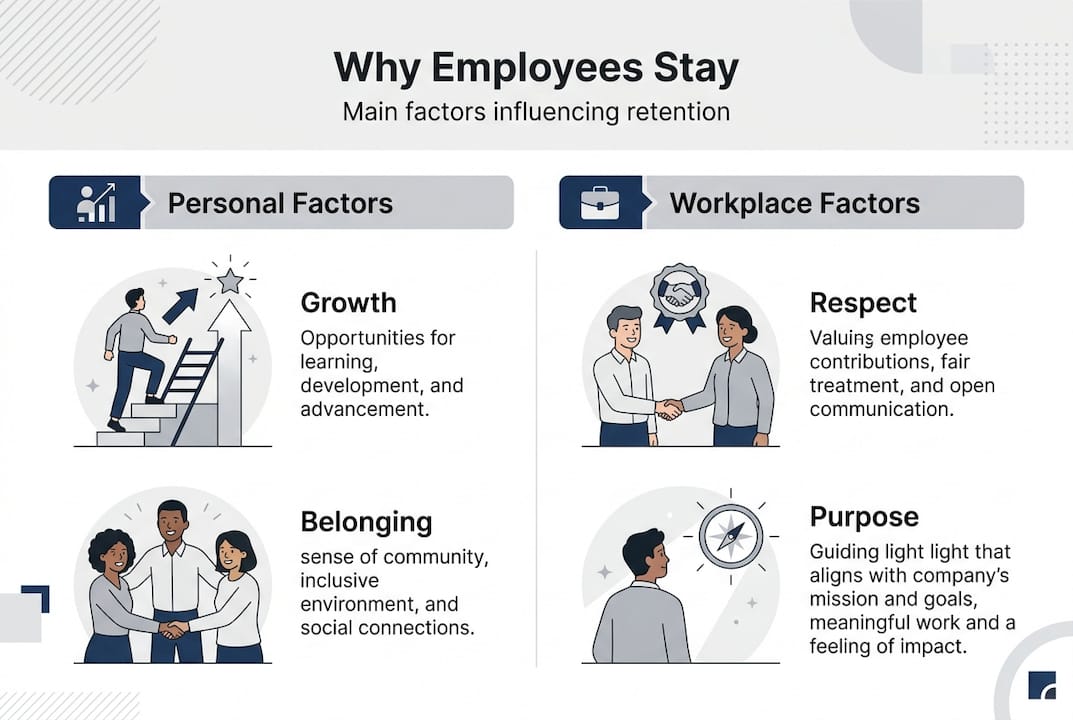
Practical Ways Leaders Can Spot Retention Risk Earlier
Leaders do not need more generic retention programs. They need earlier visibility into what is changing.
Start by looking for patterns that often appear before employees leave:
-
Reduced candor
-
Less interest in growth conversations
-
More guarded communication
-
Lower initiative
-
Friction with a manager
-
Withdrawal from team collaboration
-
Signs of values misalignment
-
Repeated concerns that never get resolved
-
High performers becoming quieter
Better leadership questions include:
| Leadership Question | What It Helps Reveal |
|---|---|
| Who still performs well but seems less invested? | Hidden disengagement |
| Who no longer talks about their future here? | Growth or retention risk |
| Where is manager-employee fit weakening? | Daily friction and trust risk |
| Which teams are carrying unresolved tension? | Team alignment risk |
| Where do employees feel unheard or unseen? | Respect and recognition gaps |
| Which high performers are becoming quieter? | Possible resignation risk |
The point is not to guess why people stay or leave. The point is to make the hidden drivers visible early enough to act.
See Why Employees Stay or Leave Before Turnover Happens
Employees stay longer when growth, values alignment, manager-employee fit, and team connection are strong.
They leave when those conditions weaken and leaders do not see it soon enough.
OpenElevator helps CEOs, founders, senior leaders, and managers detect these risks earlier.
Through a simple five-minute, bias-free survey, OpenElevator gives leaders clearer visibility into retention risk, hidden disengagement, values alignment, manager-employee fit, and team friction.
That means leaders can stop guessing why employees stay or leave and start seeing where costly turnover risk may already be forming.
Want to see what may be helping or hurting retention inside your team? Start with OpenElevator’s free team scan.
Frequently Asked Questions
Why do employees stay longer at a company?
Employees stay longer when they see growth opportunities, trust their manager, feel respected, connect with the company’s values, and work in a team environment that supports them.
Is pay the main reason employees stay?
Pay matters, especially when it is unfair or below market. But pay alone usually does not create long-term loyalty. Growth, manager fit, values alignment, recognition, and team connection also affect whether employees stay.
What makes employees leave even when pay is good?
Employees may leave despite good pay if they feel stuck, unseen, mismanaged, disconnected from company values, or drained by unresolved team friction.
How can leaders tell if employees may leave?
Leaders should watch for reduced candor, lower initiative, less interest in growth, weaker manager communication, withdrawal from team collaboration, and high performers becoming quieter.
How can leaders improve employee retention?
Leaders can improve retention by identifying hidden disengagement earlier, improving manager-employee fit, supporting growth, recognizing contribution, strengthening team alignment, and addressing friction before it becomes resignation risk.
How does OpenElevator help employees stay longer?
OpenElevator helps leaders detect retention risk, hidden disengagement, values alignment, manager-employee fit, and team friction through a five-minute, bias-free survey. This gives leaders earlier visibility into what may help employees stay or push them to leave.