
Engagement surveys can be useful, but they often miss turnover risk.
They show how employees felt at a point in time. They may reveal broad sentiment, satisfaction, or engagement trends. But they usually do not show leaders who is already becoming less aligned, less connected, or more likely to leave.
That is why leaders can see healthy engagement scores and still be surprised by resignations.
Engagement surveys, turnover data, and exit interviews are lagging indicators. They explain what happened after risk has already formed. This guide explains why engagement surveys miss turnover risk and what leaders need instead: earlier visibility into hidden disengagement, values alignment, manager-employee fit, interpersonal alignment, and team friction.
Table of Contents
Key Takeaways
| Key point | What leaders should know |
|---|---|
| Engagement surveys are lagging indicators | They show how employees felt at a point in time, but may miss what is already changing below the surface. |
| High scores can hide risk | A team can look engaged while values alignment, connection, or manager-employee fit is already weakening. |
| Averages limit action | Survey results often show broad patterns, not who is at risk, why, or what leaders should do next. |
| Fit and alignment matter | Retention risk often forms when values alignment, interpersonal alignment, or team dynamics weaken. |
| Leaders need earlier visibility | The goal is to see hidden risk before surprise resignations disrupt performance. |
What engagement surveys really measure—and miss
With this context in mind, let’s look closer at what most engagement surveys actually measure and where they fall short.
Most engagement surveys are built around what I’d call transactional engagement: satisfaction with your manager, your pay, your work environment. These are real concerns, and they matter. But they’re a bit like judging a marriage by whether the couple shares household chores fairly. Useful, sure. But it doesn’t tell you whether they actually want to stay together.
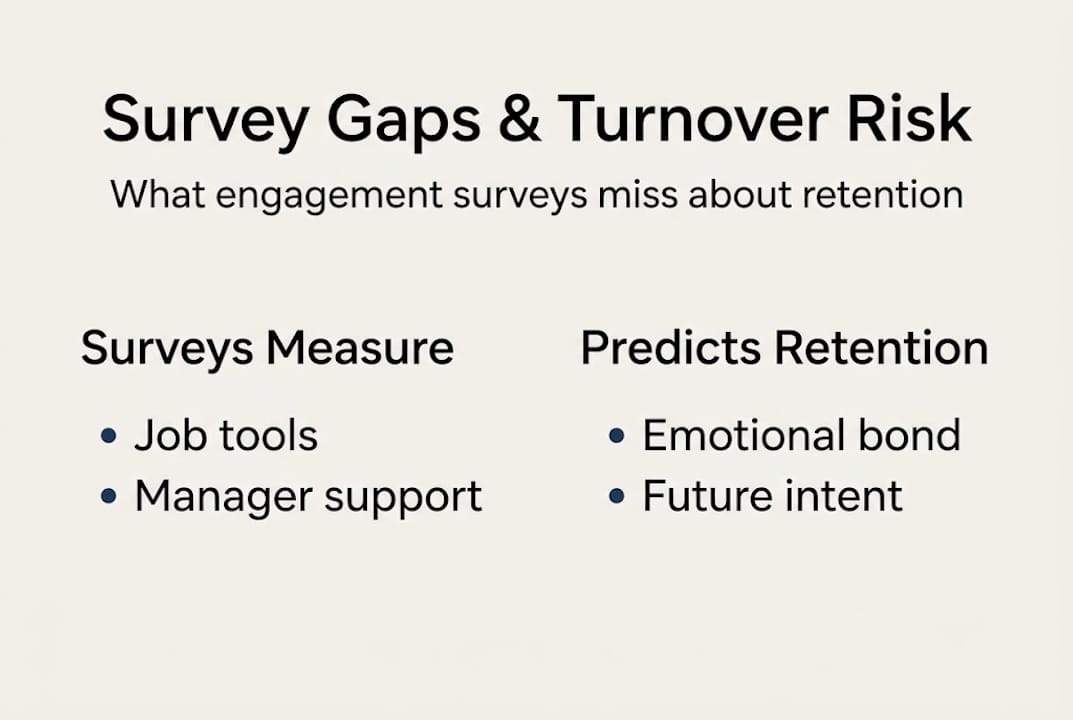
Standard engagement surveys measure transactional job satisfaction rather than deeper psychological commitment or values alignment and connection, which better predicts retention. When you ask someone “Do you have the tools to do your job?” you’re measuring logistics, not loyalty. And that distinction is everything when you’re trying to hold onto your best people.
Here’s what standard surveys typically cover, and what they quietly leave out:
What most surveys cover:
-
Satisfaction with compensation and benefits
-
Clarity of job expectations
-
Relationship with direct manager
-
Access to resources and tools
-
Work-life balance perceptions
What they miss:
-
Sense of purpose and meaning at work
-
Values alignment and connection to team and mission
-
Intent to stay over the next 6 to 12 months
-
Feeling of being genuinely respected and seen
-
Alignment between personal values and company culture
A high engagement score and a resignation letter are not mutually exclusive. The score tells you how someone feels about their job today. It says almost nothing about whether they’ll still be here tomorrow.
The table below makes this contrast concrete:
| Typical survey question | What it actually measures | What predicts retention |
|---|---|---|
| “I have the tools to do my job” | Operational satisfaction | Values alignment and connection |
| “My manager gives clear feedback” | Transactional relationship | Sense of being valued |
| “I understand company goals” | Informational clarity | Alignment with purpose |
| “I would recommend this company” | Surface-level advocacy | Intent to stay |
If your employee retention solutions are built entirely on this kind of survey data, you’re navigating with an incomplete map. The terrain is more complex than the instrument suggests.
Why values alignment and connection predict retention better
Employees stay when the work environment continues to meet what they value.
For some people, that may mean growth and opportunity. For others, it may mean safety, stability, purpose, recognition, autonomy, connection, or a strong relationship with their manager and team.
The problem is that employees do not all value the same things.
That is why broad engagement scores can be misleading. A team average may look healthy while one employee is quietly losing connection, another is no longer aligned with the work, and another is struggling with manager-employee fit or team friction.
The better question is not only, “Are employees engaged?”
The better question is, “What does each person value, and are those needs still being met?”
Leaders who can answer that question have a clearer path to retention. They can stop relying on averages, assumptions, and guesswork, and start seeing where risk is actually forming.
Why high engagement scores don’t guarantee retention
Even the best engagement scores can be misleading. Let’s examine why real turnover risk often lurks beneath the surface.

Picture this: your top-performing product manager, someone who scores consistently high on every engagement survey, walks into your office on a Tuesday morning and resigns. You’re blindsided. The scores said everything was fine. What happened?
This scenario plays out in SMEs more often than leaders want to admit. High engagement scores can mask a complicated internal reality. Here are the most common reasons high scorers still leave:
-
Burnout without visibility: They’re highly engaged because they care deeply, and that same intensity drives them to exhaustion. Nobody flags it because the scores look great.
-
Lack of meaning: They’re good at their job but no longer feel it matters. Competence and purpose are not the same thing.
-
Unaddressed concerns: They raised issues quietly, felt unheard, and eventually stopped trying. The survey score stayed high; the trust eroded underneath.
-
Better opportunity alignment: A competitor offered something that resonated more deeply with their values or growth aspirations.
-
Invisible relationship shift: A change in manager-employee fit, interpersonal alignment, or team dynamics that surveys did not capture in time.
This is the paradox that keeps good leaders up at night. The score looked fine. The person left anyway.
Pro Tip: Watch for discrepancies between a team member’s engagement score and their qualitative feedback in one-on-ones or stay conversations. When someone scores high but speaks cautiously or deflects questions about the future, that gap is worth exploring with a lower turnover approach that goes beyond the numbers.
Why survey follow-up still misses the deeper issue
Following up on survey results matters. But follow-up alone does not solve the visibility problem.
A company can respond quickly, share action plans, and still miss the people most at risk if the underlying data is too broad, too averaged, or too late.
The deeper issue is that surveys often do not show leaders:
-
What each employee values most
-
Whether those values are still being met
-
Where manager-employee fit is strained
-
Which relationships are becoming harder
-
Where team friction is forming
-
Who looks stable but may already be disengaging
Action matters, but action based on incomplete visibility can still miss the real risk.
What leaders need instead of another engagement survey
Leaders do not need another broad score. They need earlier visibility into what is changing.
A stronger retention approach should help leaders see:
-
Who is least satisfied and at higher risk of leaving
-
What each person values
-
Whether those values are being met
-
Where manager-employee fit is strong or strained
-
Who works well together and where collaboration is harder
-
Where team friction may be forming below the surface
-
Which hiring or internal transfer decisions may improve or weaken team fit
The goal is not to replace every HR process. The goal is to add the missing visibility layer: the information leaders need before turnover becomes visible.
Why leaders need to move from guessing to knowing
The problem is not that leaders do not care.
The problem is that they often do not have the right visibility early enough. They rely on engagement surveys, exit interviews, turnover reports, and gut feel, then wonder why resignations still feel surprising.
But retention risk usually starts before someone gives notice.
It can begin when values are no longer being met, when manager-employee fit becomes strained, when interpersonal alignment weakens, or when team friction quietly builds below the surface.
Leaders cannot fix what they cannot see.
The shift is from asking, “What did our survey score say?” to asking, “What is changing in the team right now?”
How OpenElevator helps leaders see retention risk earlier
Engagement surveys can show how employees felt. OpenElevator helps leaders see what may already be changing.
OpenElevator helps CEOs, founders, senior leaders, and managers see what is happening now: shifting sentiment, hidden disengagement, manager-employee misalignment, values misalignment, interpersonal alignment, and team friction before those issues become surprise resignations or disrupt performance.
Engagement surveys, turnover data, and exit interviews are lagging indicators. OpenElevator gives leaders earlier visibility into the risks forming below the surface.
Get your free OpenElevator team scan to experience the platform, gain real retention-risk visibility, and see what may be hidden below the surface — with zero cost and zero risk.

Frequently asked questions
Why do engagement surveys miss turnover risk?
Engagement surveys often miss turnover risk because they show how employees felt at a point in time. They may not reveal whether values alignment, manager-employee fit, interpersonal alignment, or team friction is already changing below the surface.
Can high engagement scores still hide resignation risk?
Yes. A person or team can appear engaged while motivation, connection, values alignment, or manager-employee fit is already weakening. Strong scores do not always mean low retention risk.
What should leaders measure instead of only engagement?
Leaders should look at values alignment, manager-employee fit, interpersonal alignment, team friction, hidden disengagement, and whether each employee’s core needs are still being met.
Are exit interviews useful for retention?
Exit interviews can explain why someone left, but they arrive too late to prevent that resignation. They are useful for learning, but not enough for early retention-risk visibility.
How does OpenElevator help leaders see turnover risk earlier?
OpenElevator helps leaders see what is happening below the surface before turnover data, exit interviews, or engagement surveys reveal the problem too late. The free team scan lets leaders experience the platform with zero cost and zero risk while gaining real visibility into hidden team risk.