
You think you know who’s at risk of leaving. You watch for the obvious signs: missed deadlines, visible frustration, a dip in output. But your best people rarely show those signs. They keep delivering, keep showing up, and then one Monday morning they hand in their notice and you’re left wondering what you missed. Gradual disengagement masks as sustained performance, which means the very thing that makes someone a high performer, their professionalism and work ethic, is also what hides the problem until it’s too late.
Table of Contents
-
Why traditional fixes fail: Top misconceptions about retention
-
A better approach: Evidence-based practices for retaining top talent
Key Takeaways
| Point | Details |
|---|---|
| Early disengagement is masked | High performers often check out long before visible signs, so leaders must monitor more than just output. |
| Recognition drives retention | Genuine, timely recognition dramatically reduces turnover risk among top talent. |
| The cost is enormous | Replacing a high performer can cost up to twice their salary and damage organizational momentum. |
| Culture outweighs compensation | Leadership quality, voice, and psychological safety influence departures more than pay alone. |
Why high performers really leave: The hidden causes
Most leaders assume that if a top performer were unhappy, they’d say something. They’d push back, ask for a raise, or at least seem a little off. That assumption is where the visibility gap begins.
The reality is that disengagement in high performers is gradual and almost perfectly camouflaged by their output. They’re still hitting targets. They’re still professional in meetings. But internally, they have disengaged. What’s driving that quiet exit?
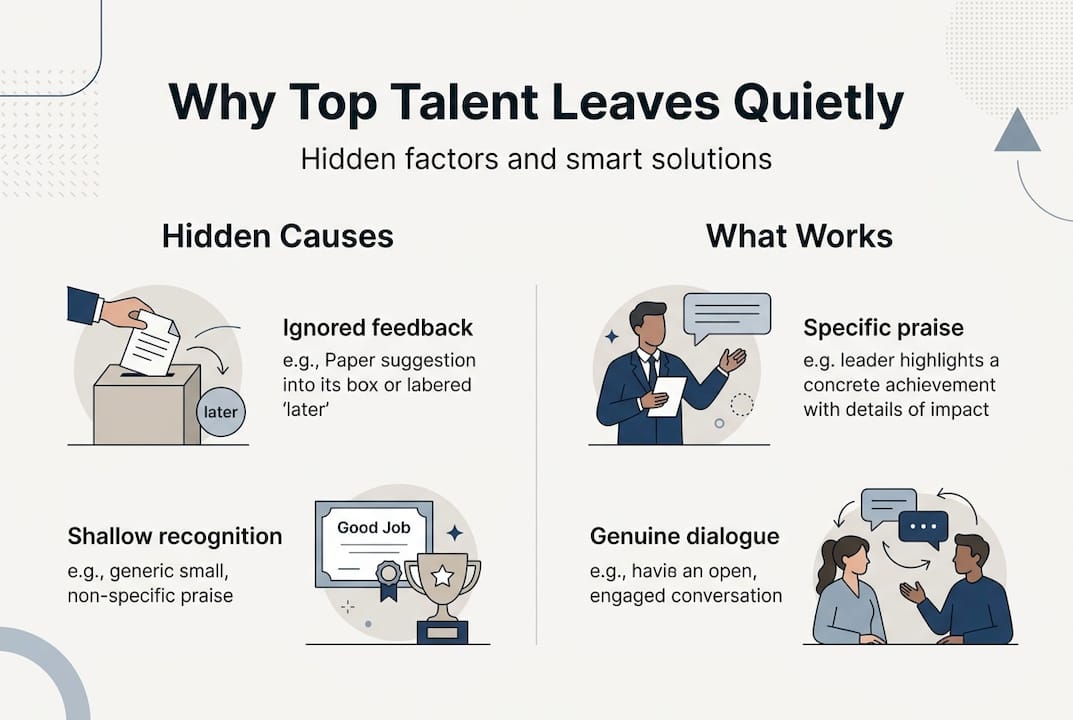
Unaddressed issues like lack of recognition, the so-called “high performer tax” (being overloaded because you’re reliable), stalled growth, poor management, and the absence of psychological safety are the real culprits. These aren’t dramatic grievances. They’re slow-burning frustrations that compound over months.
Here’s what that typically looks like in practice:
-
No recognition: Their contributions are expected, not celebrated.
-
Overload without support: They get more work because they’re good at it, with no relief in sight.
-
Stalled growth: No new challenges, no clear path forward.
-
Poor management: A boss who doesn’t listen, doesn’t advocate, or doesn’t notice.
-
Lack of psychological safety: They’ve learned that speaking up doesn’t lead anywhere good.
And here’s the part that surprises most executives: culture and leadership matter more to high performers than compensation. Money is rarely the primary reason they leave. It’s the environment. It’s whether they feel seen, heard, and valued. That’s a harder problem to solve with a salary bump.
“What leaders think is happening and what is actually happening inside their best people’s heads are often two completely different stories.”
The silent signals: What leaders are missing
So if high performers aren’t storming out or complaining loudly, what does their disengagement actually look like? The signals are there. They’re just quieter than most leaders are trained to notice.
Early warning signs include:
-
Reduced voice: They stop challenging decisions or offering alternative perspectives.
-
Less initiative: They used to volunteer for stretch projects. Now they wait to be asked.
-
Transactional communication: Emails become shorter. Conversations become functional.
-
Silence on issues: They’ve stopped flagging problems because they no longer believe it changes anything.
The reason most leaders miss these signals is straightforward. We track output, not discretionary effort. We measure what gets done, not how much of themselves someone is bringing to the work. A high performer can reduce their emotional investment by 40% and still look like a top contributor on paper.

What makes this especially tricky is the timeline. The process typically starts with feedback being ignored, which leads to reduced effort, which leads to an internal job search, often months before any resignation surfaces. By the time you notice something is off, they may already have interviews lined up.
Pro Tip: Start tracking voice patterns in your one-on-ones. Is someone who used to push back now just nodding along? That shift in behavior is data. Treat it like data.
The business impact: Costs, benchmarks, and risks
Let’s talk numbers, because this is where the stakes become impossible to ignore.
US voluntary turnover sits at roughly 13% on average, with SMEs tracking at 12% or higher. For high-skilled roles, replacing a single employee can cost up to 213% of their annual salary when you factor in recruiting, onboarding, lost productivity, and the institutional knowledge that walks out the door with them.
| Cost factor | Typical impact |
|---|---|
| Recruiting and hiring | 20-30% of annual salary |
| Onboarding and training | 10-20% of annual salary |
| Lost productivity (ramp time) | 50-100% of annual salary |
| Lost institutional knowledge | Hard to quantify, often severe |
| Team morale and disruption | Cascading, often underestimated |
Recognition is one of the clearest levers leaders can use to reduce preventable turnover. High-quality recognition reduces turnover risk by 45% over two years, and well-recognized employees are 65% less likely to be actively job hunting. That’s not a soft HR metric. That’s a hard business lever.
For SMEs specifically, the employee retention impact of losing even one or two high performers in a year can ripple through team capacity, client relationships, and culture in ways that take years to recover from. You don’t have the bench depth of a Fortune 500 company. Every departure hits harder.
The cost of losing a high performer isn’t just the replacement fee. It’s the six months of reduced output before they left, the team’s morale dip after, and the clients who noticed the change.
Why traditional fixes fail: Top misconceptions about retention
Most SME leaders, when they sense a retention problem, reach for the same toolkit. And then they’re genuinely puzzled when the high performers leave anyway.
Here’s why those fixes miss the mark:
-
Compensation adjustments address a symptom, not the cause. If someone feels invisible or undervalued, a raise tells them their time is worth more, not that they are worth more.
-
Generic perks signal that leadership doesn’t know what individuals actually need.
-
Annual engagement surveys are too infrequent and too anonymous to catch the nuanced, individual disengagement of a high performer.
-
Exit interviews are the most expensive form of feedback you can collect. By then, the decision is made.
Recognition consistently outperforms perks at reducing turnover, but only when it’s specific, timely, and genuine. “Great job this quarter” doesn’t cut it. Naming the exact behavior, the impact it had, and why it mattered? That lands differently.
Gallup’s research also shows that while work-life balance and pay top the list of reasons people take new jobs, fairness and having a voice matter most to high performers when deciding whether to stay. That’s a meaningful distinction. You’re solving for two different problems.
Pro Tip: Recognition must be specific and timely to work. “I noticed how you handled that client situation on Thursday, and the way you kept the team calm made a real difference” is retention. “You’re doing great” is noise.
A better approach: Evidence-based practices for retaining top talent
So what actually works? Here’s a practical comparison of conventional versus high-impact retention actions:
| Conventional approach | High-impact alternative |
|---|---|
| Annual salary review | Ongoing workload and growth conversations |
| Exit interviews | Stay interviews (proactive, quarterly) |
| Engagement surveys | Voice tracking and sentiment monitoring |
| Generic recognition programs | Specific, timely, individual recognition |
| Perks and benefits upgrades | Addressing the “high performer tax” directly |
Here’s a numbered playbook you can start using this quarter:
-
Run stay interviews. Ask your top performers directly: what keeps you here, and what would make you consider leaving? Do this before you need to, not after.
-
Track voice and silence as data. Who has gone quiet in meetings? Who used to challenge ideas and no longer does? These are leading indicators, not lagging ones.
-
Rebalance workloads. Identify who is carrying disproportionate load and address it explicitly. High performers notice when underperformance around them goes unaddressed.
-
Act on feedback visibly. When someone raises an issue and nothing changes, they learn that speaking up is pointless. Close the loop, every time.
-
Make recognition specific and frequent. Recognition programs that are well-executed drive 31% lower turnover. The investment is minimal. The return is not.
Acting on feedback and making employee voice visible is not a soft initiative. It’s one of the highest-ROI leadership behaviors available to you.
Stay interviews work best when they’re low-stakes and genuinely curious, not performance reviews in disguise. The goal is to understand, not to reassure yourself that everything is fine.
See Which High Performers May Already Be Pulling Away
High performers rarely disengage loudly.
They keep delivering, stay professional, and continue showing up while trust, motivation, or alignment quietly weakens beneath the surface. By the time they resign, the risk has usually been building for months.
OpenElevator helps CEOs, founders, senior leaders, and managers detect hidden retention risk, manager-employee friction, values misalignment, and team dynamics that may not show up in performance metrics.
The free team scan gives leaders earlier visibility into where top talent may be quietly pulling away before it becomes a costly resignation.
Get your free OpenElevator team scan and see what may be hidden below the surface.
Frequently Asked Questions
Why do high performers leave quietly?
High performers often leave quietly because they keep performing even after they have started disengaging. Lack of recognition, excessive workload, poor manager support, stalled growth, or lack of voice can build over time until resignation becomes the final signal.
What are the early warning signs a high performer may leave?
Early warning signs include reduced initiative, less pushback in meetings, shorter communication, fewer new ideas, declining enthusiasm, and silence around issues they used to raise. Output may still look strong while commitment is weakening.
Is compensation the main reason high performers leave?
Compensation can matter, but high performers often leave because of leadership, growth, recognition, workload, and manager-employee fit. A raise may not fix the deeper problem if the employee feels unseen, overloaded, or misaligned.
Why are high performers harder to identify as retention risks?
High performers are often professional enough to hide disengagement. They may continue hitting deadlines and supporting the team while privately deciding whether to leave. That makes early visibility especially important.
How can OpenElevator help retain high performers?
OpenElevator helps leaders detect hidden retention risk, manager-employee friction, values misalignment, and team dynamics that may not appear in standard performance metrics. The free team scan helps leaders see where risk may be forming before a high performer resigns.