High performers rarely quit without warning. They quit without leaders seeing the warning.
The employee may still deliver strong work. They may still meet deadlines, solve problems, and look reliable on the surface. But underneath, hidden disengagement may already be forming. They may stop sharing ideas, stop challenging decisions, stop volunteering for difficult work, or stop seeing a future inside the company.
That is what makes high-performer turnover so dangerous. Performance can stay high while commitment is already dropping.
For CEOs, founders, senior leaders, and managers, the risk is not only losing a strong employee. The risk is missing the quiet signals that came before the resignation.
This article explains why high performers quit without warning, what leaders should watch for, and how earlier visibility into retention risk, manager-employee fit, values alignment, and team friction can help prevent costly resignations.
Table of Contents
Key Takeaways
| Point | Details |
|---|---|
| High performers often hide disengagement | They may keep delivering results while quietly withdrawing effort, voice, and commitment. |
| Performance is not the only signal | Leaders need to watch for changes in communication, initiative, trust, and team connection. |
| The risk starts before resignation | Hidden disengagement, weak manager fit, burnout, and values misalignment may build for months. |
| Retention requires earlier visibility | Leaders cannot protect top talent if they cannot see where risk is forming. |
| The fix is targeted action | Workload balance, growth clarity, recognition, manager fit, and team alignment all affect retention. |
Why High Performers Disengage Before They Quit
High performers often disengage quietly.
They may not complain. They may not miss deadlines. They may not create visible conflict. In fact, they may continue producing strong work long after they have started questioning whether they want to stay.
That is why standard performance metrics can mislead leaders. A high performer can look successful on paper while mentally checking out.
The first signs are often behavioral:
-
They contribute less in meetings
-
They stop challenging weak decisions
-
They volunteer for fewer stretch projects
-
They become more transactional in communication
-
They stop mentoring or helping others as much
-
They show less interest in long-term plans
-
They avoid deeper conversations with their manager
The issue is not always sudden dissatisfaction. It is often a slow decline in trust, motivation, alignment, or belief that staying is worth it.
The resignation is not the first warning. It is usually the final one.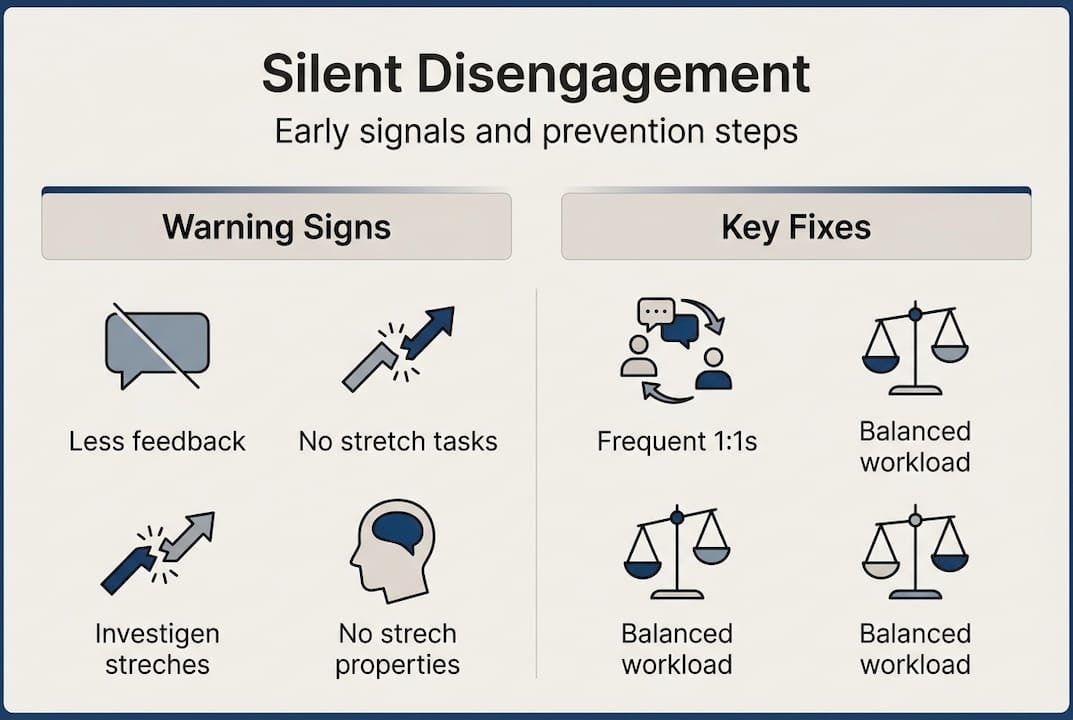
Key Reasons High Performers Leave Without Warning
High performers usually leave when the cost of staying becomes higher than the risk of leaving.
They may still care about the work. They may still like some of their colleagues. But if the environment keeps draining them, they eventually protect their future by moving on.
Common reasons high performers leave include:
| Reason | What It Looks Like | Retention Risk |
|---|---|---|
| Unfair workload | The strongest employees carry the hardest work repeatedly | Burnout and resentment increase |
| Lack of growth | The employee no longer sees a clear path forward | They start looking elsewhere |
| Poor manager fit | Communication, trust, or feedback breaks down | Hidden disengagement builds |
| Low recognition | Strong work becomes expected but not valued | Motivation declines |
| Values misalignment | The employee feels disconnected from how decisions are made | Commitment weakens |
| Team friction | Collaboration becomes harder or politically draining | Energy shifts away from contribution |
| Compensation mismatch | Pay no longer reflects contribution or market value | External offers become more attractive |
The biggest mistake leaders make is assuming high performance means high commitment.
It does not.
A high performer can still deliver while already deciding whether to leave.
Early Warning Signs Leaders Should Watch For
High performers often show warning signs before they resign. The problem is that leaders dismiss them because performance has not dropped yet.
Watch for changes in behavior, not just output.
| Warning Sign | What It May Mean |
|---|---|
| Less candor in meetings | They may no longer believe speaking up is worth it |
| Fewer new ideas | They may be withdrawing discretionary effort |
| Less volunteering | They may be protecting energy or disengaging |
| Shorter communication | They may be becoming more transactional |
| Reduced interest in growth conversations | They may no longer see their future inside the company |
| Less cross-team collaboration | They may be pulling back from broader commitment |
| More frustration with decisions | Trust or values alignment may be weakening |
| Sudden neutrality | They may have mentally checked out |
Silence is not always satisfaction.
For high performers, silence can be a sign that they have stopped trying to improve the company and started preparing to leave it.

Seven Practical Fixes to Retain High Performers
1. Stop rewarding strong performance with more overload
High performers often become the default owners of difficult work. That may solve short-term execution problems, but it creates long-term retention risk.
Review workload distribution regularly. If the same people always carry the hardest work, burnout is already forming.
2. Give them visible growth paths
High performers need to see a future. If they cannot see the next challenge, responsibility, or development path inside the company, they will look outside.
Growth does not always mean promotion. It can mean strategic projects, expanded ownership, mentoring, skill-building, or clearer influence.
3. Watch manager-employee fit closely
Many high performers leave because the manager relationship stops working.
Leaders should look for communication gaps, trust issues, unclear expectations, lack of autonomy, or feedback styles that create friction.
4. Recognize contribution before it becomes expected
High performers often hear from leaders only when something is urgent or broken.
Recognition should be specific, timely, and tied to real contribution. The message should not be “do more.” It should be “we see the value you create.”
5. Protect autonomy
High performers usually want room to think, solve, and lead. Micromanagement can turn strength into frustration.
Give clear outcomes, context, and decision rights. Do not bury strong people under unnecessary control.
6. Look for hidden team friction
A high performer may be struggling because the team around them is misaligned, slow, political, or difficult to work with.
Team friction drains energy. If leaders ignore it, the strongest people may leave first because they have the most options.
7. Detect retention risk before performance drops
Do not wait for a decline in output. By then, the employee may already be gone emotionally.
Leaders need earlier visibility into hidden disengagement, values alignment, manager-employee fit, and team dynamics so they can act before resignation becomes the final signal.
See High-Performer Retention Risk Before It Becomes Resignation
High performers do not always look disengaged before they leave.
They may still deliver strong work while trust, motivation, values alignment, or manager-employee fit is already weakening. By the time performance drops, the resignation may already be close.
OpenElevator helps CEOs, founders, senior leaders, and managers detect these risks earlier.
Through a simple five-minute, bias-free survey, OpenElevator gives leaders clearer visibility into retention risk, hidden disengagement, values alignment, manager-employee fit, and team friction.
That means leaders can stop relying on surface-level performance and start seeing where high-performer turnover risk may already be forming.
Want to see where high-performer retention risk may be hiding in your team? Start with OpenElevator’s free team scan.
Frequently Asked Questions
Why do high performers quit without warning?
High performers often quit without warning because they keep delivering results while quietly disengaging. Leaders may not notice the risk until the employee has already decided to leave.
What are early signs a high performer may leave?
Early signs include less candor, fewer ideas, lower participation, reduced volunteering, shorter communication, weaker interest in future plans, and less connection with the manager or team.
Why is high-performer turnover so costly?
High-performer turnover is costly because the company loses knowledge, speed, credibility, client trust, and team stability. Other employees may also absorb extra work after the person leaves.
How can leaders retain high performers?
Leaders can retain high performers by balancing workload, creating visible growth paths, improving manager-employee fit, recognizing contribution, protecting autonomy, and detecting hidden disengagement earlier.
Does strong performance mean someone is engaged?
No. A high performer may continue delivering strong work while mentally checking out. Performance can remain high even when motivation, trust, or commitment is already declining.
How does OpenElevator help retain high performers?
OpenElevator helps leaders detect retention risk, hidden disengagement, values alignment, manager-employee fit, and team friction through a five-minute, bias-free survey. This gives leaders earlier visibility before top performers resign.