
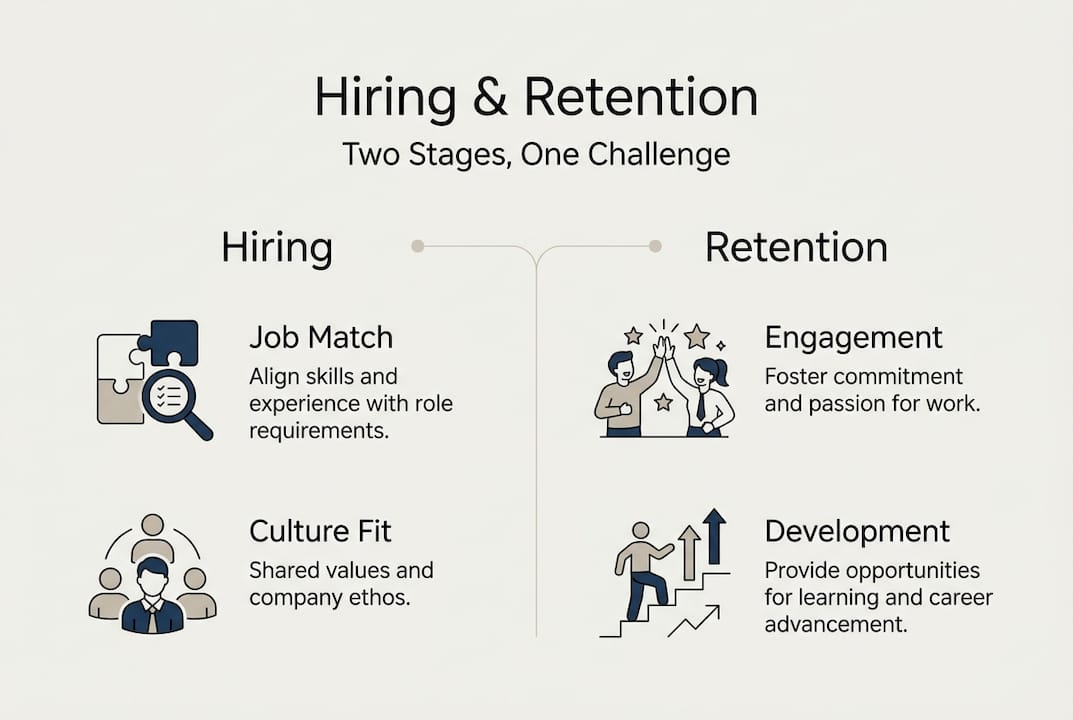
Hiring and retention are often treated as separate problems. They are not.
A hiring mistake often becomes a retention problem later. A candidate who looks strong on paper may still become a turnover risk if the role, manager, values, or team environment are misaligned.
That is why retention does not start when someone becomes disengaged. It starts before the offer is made.
When leaders hire without understanding values alignment, manager-employee fit, team dynamics, and long-term role fit, they may be creating tomorrow’s resignation. The employee may start strong, then slowly disconnect as expectations, working style, or team friction begin to show.
For CEOs, founders, senior leaders, and managers, the lesson is simple: hiring and retention are the same risk viewed at different moments in time.
This article explains why hiring and retention must be connected, how poor fit becomes turnover risk, and how earlier visibility helps leaders protect team stability before costly resignations happen.
Table of Contents
Key takeaways
| Point | Details |
|---|---|
| Hiring and retention are connected | Poor hiring decisions often become future turnover problems. |
| Fit matters beyond skills | Values alignment, role fit, manager-employee fit, and team alignment all affect retention risk. |
| Turnover starts before resignation | Misalignment may build quietly for months before an employee leaves. |
| Hiring mistakes are expensive | A poor-fit hire can damage productivity, trust, morale, and team stability. |
| Earlier visibility reduces risk | Leaders need to see fit and alignment before hiring and throughout the employee lifecycle. |
Understanding Why Hiring and Retention Are the Same Problem
Retention does not begin when an employee starts thinking about leaving. It begins during hiring.
Every hiring decision shapes future retention risk. The way the role is described, the expectations set, the manager relationship, the values match, and the team environment all affect whether a person is likely to stay and perform.
A person can have the right skills and still be the wrong fit.
Common hiring decisions that become retention problems include:
-
Hiring for technical ability while ignoring values alignment
-
Overselling the role to close the candidate
-
Failing to assess manager-employee fit
-
Ignoring team dynamics
-
Rushing the process because the role is urgent
-
Avoiding honest conversations about workload, expectations, or growth
-
Assuming performance skills will overcome poor alignment
The question is not only, “Can this person do the job?”
The better question is, “Is this person likely to succeed, stay, and contribute in this role, with this manager, on this team?”
| Hiring Decision | Future Retention Risk |
|---|---|
| Role is oversold | Employee feels misled after joining |
| Manager fit is ignored | Friction builds after onboarding |
| Values alignment is weak | Commitment drops over time |
| Team fit is unclear | Collaboration becomes harder |
| Growth expectations are vague | Employee starts looking elsewhere |
| Hiring is rushed | Poor fit becomes expensive later |
Hiring and retention are not separate issues. Hiring is where many retention problems begin.
The High Cost of Ignoring the Hiring-Retention Connection
Poor hiring fit is expensive because the cost does not show up all at once.
At first, the new hire may seem fine. They attend meetings, complete onboarding, and start contributing. But over time, small signs may appear. Communication becomes strained. Motivation drops. The manager relationship weakens. The person does not connect with the team. Expectations do not match reality.
By the time the person resigns, the company has already paid for months of misalignment.
| Cost Area | What Happens | Business Impact |
|---|---|---|
| Recruiting cost | Time and money are spent filling the role | Budget is wasted if the hire leaves early |
| Onboarding cost | Managers and teammates invest time in ramp-up | Productivity is delayed |
| Team disruption | Other employees adjust around the poor fit | Morale and trust decline |
| Manager time | Leaders spend time addressing preventable friction | Focus shifts away from growth |
| Productivity loss | The employee contributes less than expected | Execution slows |
| Replacement cost | The role must be filled again | The cycle repeats |
| Trust damage | Employees see repeated hiring mistakes | Confidence in leadership weakens |
The most dangerous hiring mistakes are not always obvious immediately. They become visible later as hidden disengagement, team friction, or resignation risk.

How Fit, Alignment, and Team Dynamics Connect Hiring to Retention
A strong hire is not just someone who can perform the tasks. A strong hire is someone whose skills, values, working style, manager relationship, and team environment support long-term contribution.
Leaders should evaluate four types of fit:
| Type of Fit | What It Means | Why It Affects Retention |
|---|---|---|
| Role fit | The person’s skills, strengths, and preferences match the job | Poor role fit creates frustration or underperformance |
| Values alignment | The person’s values match how the company operates | Weak alignment reduces trust and commitment |
| Manager-employee fit | The person and manager can communicate and work effectively | Poor fit creates hidden friction and disengagement |
| Team alignment | The person works well with the team’s communication and collaboration style | Weak alignment affects productivity and belonging |
Hiring decisions should not stop at capability. Capability answers whether someone can do the work. Fit answers whether they are likely to keep doing the work well inside this environment.
When leaders ignore fit, they may not see the risk until later. The employee may look fine on the surface while motivation, trust, or alignment is already weakening.
Why Mid-Sized Companies Feel Hiring Mistakes Faster
Mid-sized companies often feel poor-fit hiring decisions faster than larger organizations.
There is less room to absorb disruption. One poor-fit hire can slow a team, increase manager stress, affect customer delivery, and create tension among employees who have to compensate.
This is especially true when the hire is a manager, senior individual contributor, or client-facing employee.
| Mid-Sized Company Reality | Why It Matters |
|---|---|
| Leaner teams | One resignation creates more disruption |
| Fewer layers | Manager-employee friction becomes visible faster |
| Limited backup capacity | Knowledge loss hurts execution |
| Faster growth pressure | Hiring mistakes compound quickly |
| Close team dynamics | Poor team fit affects morale faster |
| Less tolerance for repeated rework | Rehiring drains time and focus |
For growing companies, hiring with retention in mind is not a nice-to-have. It is a stability issue.
Practical Strategies for Hiring With Retention in Mind
Hiring with retention in mind means evaluating whether a candidate is likely to succeed after the excitement of the offer is gone.
Leaders should build hiring processes that reveal fit before the person joins.
Focus on:
-
Clear role expectations
-
Honest discussion of challenges
-
Values alignment
-
Manager-employee working style
-
Team collaboration style
-
Career expectations
-
Preferred feedback and communication patterns
-
Motivation for joining
-
Likelihood of staying beyond the first year
| Hiring Question | What It Reveals |
|---|---|
| What type of manager helps you do your best work? | Manager-employee fit |
| What kind of team environment frustrates you? | Team alignment risk |
| What matters most to you in how a company operates? | Values alignment |
| What would make this role feel successful after one year? | Retention expectations |
| What has caused you to leave past roles? | Future turnover risk |
| What type of feedback helps you improve? | Communication fit |
| What do you need to stay engaged long term? | Retention drivers |
The goal is not to make hiring slower. The goal is to stop creating future turnover by hiring without enough visibility.
See Hiring and Retention Risk Before It Becomes Turnover
Hiring and retention are connected by fit.
A candidate who is misaligned with the role, manager, team, or values may become a retention risk later. The resignation may happen months after hiring, but the risk often started much earlier.
OpenElevator helps CEOs, founders, senior leaders, and managers see that risk earlier.
Through a simple five-minute, bias-free survey, OpenElevator gives leaders clearer visibility into values alignment, manager-employee fit, team alignment, hidden disengagement, and retention risk.
That means leaders can make better hiring decisions and detect retention risk before misalignment turns into costly turnover.
Want to see where hiring and retention risk may already be forming in your team? Start with OpenElevator’s free team scan.
Frequently Asked Questions
Why are hiring and retention connected?
Hiring and retention are connected because the quality of hiring decisions affects whether employees stay. Poor role fit, values misalignment, weak manager-employee fit, or team friction can become turnover risk later.
How can poor hiring lead to turnover?
Poor hiring can lead to turnover when the employee’s expectations, working style, values, role fit, or manager relationship do not match the reality of the job. The employee may disengage before eventually resigning.
What should leaders assess before hiring?
Leaders should assess skills, role fit, values alignment, manager-employee fit, team alignment, communication style, growth expectations, and whether the person is likely to stay and contribute long term.
Is retention only a problem after someone is hired?
No. Retention risk can begin during hiring if leaders do not understand whether the person fits the role, manager, team, and company values. Retention starts before the offer is accepted.
How can leaders reduce turnover through better hiring?
Leaders can reduce turnover by hiring for long-term fit, setting honest expectations, assessing manager-employee fit, checking values alignment, and understanding how the candidate will work with the team.
How does OpenElevator help with hiring and retention?
OpenElevator helps leaders see values alignment, manager-employee fit, team alignment, hidden disengagement, and retention risk through a five-minute, bias-free survey. This helps leaders make better hiring decisions and detect turnover risk earlier.