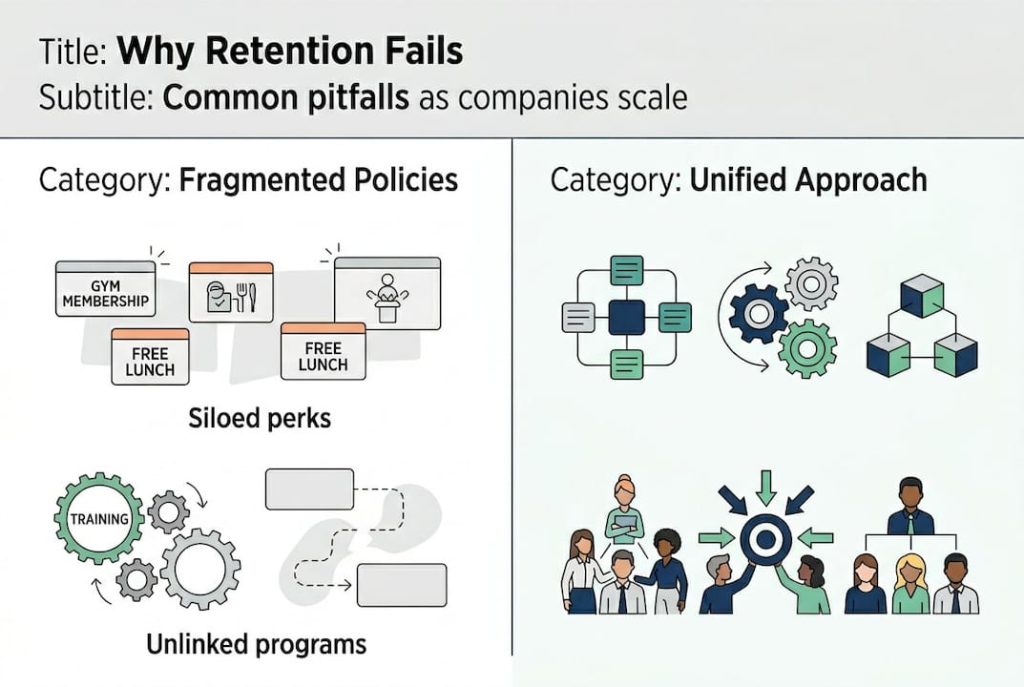
Retention strategies often look like they are working until growth exposes the gaps.
A company may add perks, run engagement surveys, improve benefits, or hire a People leader and still get surprised by resignations. The problem is not always a lack of effort. It is often a lack of visibility.
As companies scale, leaders can lose sight of what is changing below the surface: manager-employee misalignment, hidden disengagement, values misalignment, team friction, and shifting sentiment that has not yet shown up in turnover data.
Engagement surveys, turnover reports, and exit interviews are lagging indicators. They explain the problem after risk has already formed. This guide explains why retention strategies fail in growing companies and how leaders can see what is happening early enough to act.
Table of Contents
-
The myth of isolated policies: Why tactics lose power at scale
-
Leadership gaps: How manager-employee alignment undermines retention
-
Growth pains and the scaling trap: Why strategies must adapt
-
Our take: Integrated retention isn’t optional in 2026—it’s survival
Key Takeaways
| Key Point | What Leaders Should Know |
|---|---|
| Retention tactics break at scale | Perks, surveys, and isolated policies often fail when company complexity increases. |
| Lagging indicators arrive too late | Turnover data, exit interviews, and annual engagement surveys often explain problems after resignations have already formed. |
| Manager-employee alignment matters | The same management style can build trust with one employee and create friction with another. Retention risk often forms when manager-employee fit weakens below the surface. |
| Growth changes the risk profile | What worked at 60 employees may not reveal what is happening at 300. |
| Visibility is the missing layer | Leaders need to see shifting sentiment, misalignment, and team friction before they disrupt performance. |
The myth of isolated policies: Why tactics lose power at scale
When turnover spikes, the instinct is to throw something at it. A bonus here. A free lunch program there. Maybe a wellness stipend. These feel like action. They look like caring. But they are unlikely to improve retention if they do not address the real issue underneath.
Retention strategies fail when they exist as disconnected policies rather than as a unified system that supports employees across their entire lifecycle. That’s not an opinion—it’s a pattern we see repeatedly in mid-sized companies that are scaling fast. Each department runs its own retention initiative. HR has one program. The sales leader has another. Nobody’s talking to each other, and the employee in the middle feels none of it.
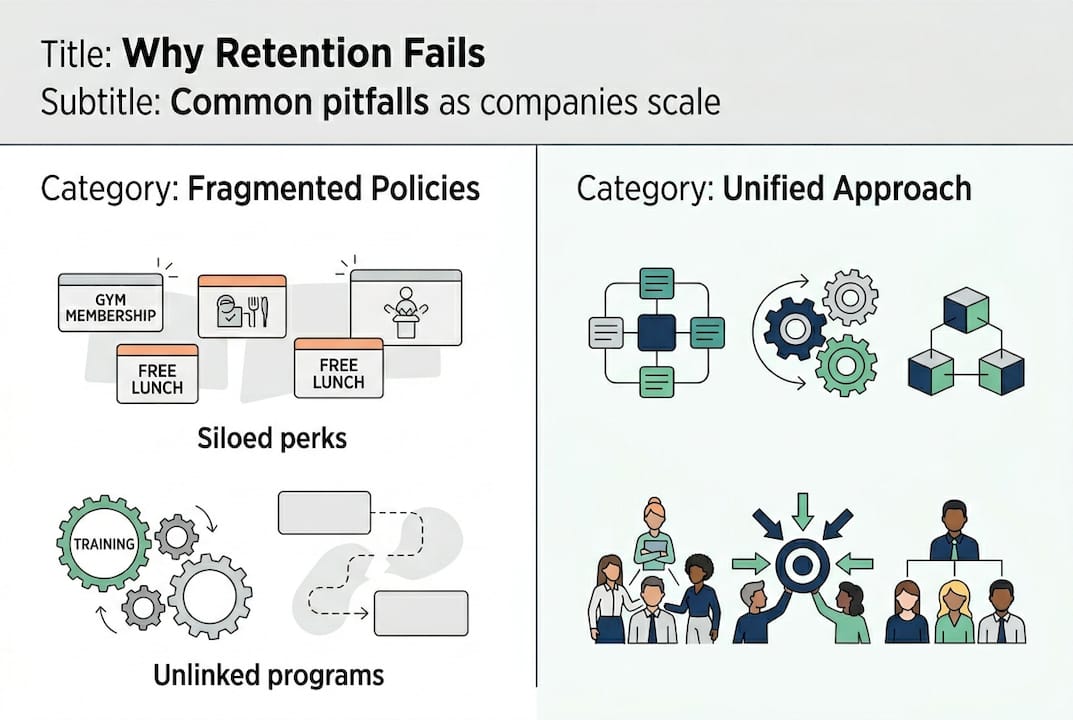
Top-quartile firms do something different. They build cohesive retention approaches that connect onboarding, development, performance, and recognition into a single, reinforcing system. The contrast is stark:
| Approach | Typical outcome |
|---|---|
| Isolated tactic (bonus, perk) | Short-term satisfaction, no behavior change |
| Siloed HR program | Low adoption, inconsistent manager buy-in |
| Integrated retention system | Measurable reduction in voluntary exits |
| Lifecycle-aligned strategy | Sustained engagement across growth phases |
The table above isn’t just theoretical. It reflects what actually happens when companies audit their retention spending and trace it back to outcomes. Most of the money goes to tactics that feel good in a board meeting but don’t move the needle.
Pro Tip: Schedule a one-hour audit of your current retention efforts. List every initiative, then ask: does this connect to anything else we do? If the answer is mostly “no,” you have a fragmentation problem, not a budget problem.
The real danger is that fragmented programs create a false sense of security. Leaders see activity and assume progress. Meanwhile, disengagement builds quietly.
Leadership Gaps: How Manager-Employee Alignment Undermines Retention
It might be your manager-employee alignment that is the problem.
Not because anyone is a bad person. Not because the manager is failing. But because people skills are not one-size-fits-all. The same management style can build trust with one employee and create friction with another.
That is where many growing companies miss the real retention risk.
A manager may be clear, direct, and efficient. One employee may experience that as helpful structure. Another may experience it as cold, dismissive, or hard to approach.
A manager may be collaborative and flexible. One employee may feel empowered. Another may feel unsupported or unclear about expectations.
The issue is not always manager quality. Often, it is manager-employee fit.
When that fit is strained, the signs can stay hidden for months. The employee may keep performing, attending meetings, and saying things are fine while trust, motivation, or alignment quietly weakens below the surface.
Common manager-employee alignment risks include:
-
Communication styles that do not match
-
Feedback that lands differently than intended
-
Expectations that feel clear to one person and vague to another
-
Values or work preferences that create quiet friction
-
Employees who stop speaking up because they do not feel understood
-
Managers who believe everything is fine because performance still looks stable
This is why engagement surveys and exit interviews often arrive too late. They may show that sentiment dropped or explain why someone left, but they usually do not reveal the manager-employee misalignment while there is still time to act.
Growing companies do not need to blame managers. They need better visibility into the relationships, values, and team dynamics that determine whether people can work well together over time.

Missed growth and learning: The silent churn accelerant
If you asked your top performers today why they’d leave, most of them wouldn’t say “the pay” or “the commute.” They’d say something like, “I just don’t see where this is going for me.” Career stagnation is one of the quietest and most powerful drivers of voluntary exits, especially among the people you can least afford to lose.
Lack of career growth and visible development opportunities is a primary driver of preventable turnover in expanding firms. High performers, almost by definition, want to keep growing. When they can’t see a path forward, they start looking for one somewhere else.
| Company type | Average voluntary turnover rate |
|---|---|
| No structured career development | 28-34% annually |
| Informal mentoring only | 20-24% annually |
| Structured learning pathways | 12-16% annually |
| Integrated development and career pathing | 8-12% annually |
The data is hard to argue with. And yet most mid-sized companies still rely on generic learning management systems that employees log into once during onboarding and never touch again.
Here’s what actually moves the needle on development-driven retention:
-
Map visible career paths for each role, not just vague “growth opportunities” language in job postings
-
Assign development conversations as a standing agenda item in manager one-on-ones, not just annual reviews
-
Offer role-specific learning budgets that employees control, rather than company-wide generic training catalogs
-
Create internal mobility programs so high performers can grow without leaving the organization
-
Recognize skill development publicly, making growth visible and aspirational across teams
Companies that invest in career path solutions and build healthy learning cultures see measurable results. Research shows that companies with healthy cultures experience 11% lower turnover than those without. That’s not a rounding error. At a 500-person company, 11% fewer exits could mean saving millions in replacement costs annually.
The difference between a generic training program and a tailored learning intervention is the difference between an employee who feels seen and one who feels like a number.
Growth pains and the scaling trap: Why strategies must adapt
There’s a specific moment in a company’s growth where everything that used to work stops working. You cross a revenue threshold, add a few hundred employees, maybe open a second office. And suddenly the culture that felt like your competitive advantage starts to feel like a memory. This is the scaling trap, and it catches a lot of leadership teams completely off guard.
Retention worsens in scaling companies due to a combination of factors: lower-quality talent acquisitions made under hiring pressure, relying heavily on gut feelings versus data on alignment, increased competition for experienced employees, and a failure to adapt strategies that worked at smaller scale. What felt like a tight, aligned team at 80 people starts to feel fragmented and anonymous at 400.
The triggers that make scaling companies most vulnerable include:
-
Increased external competition from better-funded or more flexible employers targeting your talent
-
Increased strain from manager-employee misalignment as teams grow quickly without relationship visibility
-
Communication breakdowns between executive vision and front-line reality
-
Compensation compression where newer hires earn close to or equal to experienced staff
The numbers tell a stark story. Churn worsens from 12.1% for companies under $1M ARR to 20.2% for those over $20M ARR in consumer-facing firms. Nearly double. That’s not a coincidence. That’s the scaling trap in action.
Pro Tip: At each major growth milestone (headcount doublings, new office openings, leadership changes), conduct a retention health check. Ask: are our current strategies designed for where we are now, or where we were 18 months ago?
The companies that navigate this well are the ones that treat adapting retention as you scale as a deliberate, ongoing discipline rather than a one-time project. Diagnosis first. Perks second. Always.
Our take: Integrated retention isn’t optional in 2026—it’s survival
The companies that retain their best people are not simply doing more. They are seeing more clearly.
The true differentiator isn’t the size of the benefits package or the quality of the office snacks. It’s whether the organization has built a system that gives leaders real visibility into what’s happening, before it becomes a resignation. Retention treated as a board-level, interdisciplinary discipline produces fundamentally different outcomes than retention treated as an HR checkbox.
The empirical evidence backs this up.
Top-quartile firms achieve 90 to 94% retention rates by using diagnosis-first approaches rather than perk-driven programs.
That benchmark should reframe how you think about your own retention investment. If you’re not starting with evidence-based retention diagnostics, you’re essentially guessing. And in a competitive talent market, guessing is expensive. Senior leaders need to stop asking “what perks should we add?” and start asking “what do we actually know about why people are leaving, and what are we building to prevent it?”
How OpenElevator Helps Leaders See Retention Risk Earlier
Retention strategies fail when leaders only see the problem after it has already become turnover.
OpenElevator helps CEOs, founders, senior leaders, and managers see what is happening now: shifting sentiment, hidden disengagement, manager-employee misalignment, values misalignment, and team friction before those issues become surprise resignations or disrupt performance.
Engagement surveys, turnover data, and exit interviews are lagging indicators. OpenElevator gives leaders earlier visibility into the risks forming below the surface.
Get your free OpenElevator team scan to experience the platform, gain real retention-risk visibility, and see what may be hidden below the surface — with zero cost and zero risk.
Frequently asked questions
Why do retention strategies fail in growing companies?
Retention strategies often fail because they are built as isolated tactics instead of visibility systems. As companies grow, leaders may lose sight of shifting sentiment, manager-employee misalignment, values misalignment, team friction, and hidden disengagement until those issues become resignations.
Why are engagement surveys not enough to prevent turnover?
Engagement surveys are lagging indicators. They show how employees felt at a point in time, but they may miss whether sentiment, alignment, manager fit, or team dynamics are already changing below the surface.
What causes retention risk during company growth?
Common causes include manager-employee misalignment, unclear career paths, culture dilution, communication breakdowns, values misalignment, team friction, and teams outgrowing informal leadership habits.
Why do perks fail to improve retention?
Perks can improve employee experience, but they do not reveal where retention risk is forming. If the real issue is manager friction, misalignment, burnout, or lack of growth, perks may create temporary satisfaction without solving the deeper problem.
How does OpenElevator help growing companies reduce retention risk?
OpenElevator helps leaders see what is happening below the surface before turnover data, exit interviews, or engagement surveys reveal the problem too late. The free team scan lets leaders experience the platform with zero cost and zero risk while gaining real visibility into hidden team risk.