Prediction can tell leaders who might be at risk of leaving.
It cannot always explain why.
That difference matters. A dashboard may flag three employees as possible retention risks, but each one may need something completely different. One may be burned out. One may feel misaligned with their manager. One may feel invisible. One may no longer see a future inside the company. One may not be a real risk at all.
The risk score is only the beginning.
Leaders do not reduce turnover by predicting who might leave. They reduce avoidable turnover by understanding what is driving the risk and acting before resignation becomes the first clear signal.
This guide explains why understanding people beats simply predicting who will leave, how predictive retention tools can help, where they fall short, and why leaders need deeper visibility into values alignment, interpersonal alignment, team friction, and hidden disengagement.
Table of Contents
-
How Predictive Retention Models Work and Where They Fall Short
-
How OpenElevator Helps Leaders Understand Retention Risk Earlier
Key Takeaways
| Point | Details |
|---|---|
| Prediction is not understanding | A risk score may show who needs attention, but it does not explain what is driving the risk. |
| Context changes the solution | The same retention signal can come from burnout, manager friction, lack of growth, values misalignment, or team tension. |
| Generic interventions fail | Blanket raises, vague check-ins, or broad engagement programs often miss the real reason someone may leave. |
| Better visibility improves action | Leaders need to see values alignment, interpersonal alignment, team friction, and hidden disengagement earlier. |
| OpenElevator goes beyond prediction | OpenElevator helps leaders understand where retention risk, misalignment, and hidden friction may already be forming. |
Prediction vs. Understanding: Why the Difference Matters
Prediction and understanding are not the same.
Prediction answers one question:
Who may be at risk?
Understanding answers the more important question:
Why might they be at risk?
That distinction matters because the same risk signal can point to completely different problems.
One employee may be at risk because they feel overloaded. Another may be frustrated with their manager. Another may feel disconnected from the company’s values. Another may feel underused. Another may be struggling with team friction that no one has addressed.
If leaders treat all of those people the same, they will solve the wrong problem.
A risk score can help leaders know where to look. It should not tell them what to do without deeper context.
The better retention question is not only:
“Who might leave?”
The better question is:
“What is happening in this person’s work experience that may make leaving more likely?”
That is where understanding becomes more valuable than prediction alone.
Here’s a quick way to see the contrast:
| Dimension | Prediction | Understanding |
|---|---|---|
| Core question | Who may be at risk? | Why may they be at risk? |
| Output | Risk score or flag | Root cause and better next action |
| Best use | Prioritizing attention | Designing the right intervention |
| Limitation | Can miss context | Requires deeper visibility |
| Leadership value | Shows where to look | Shows what may need to change |
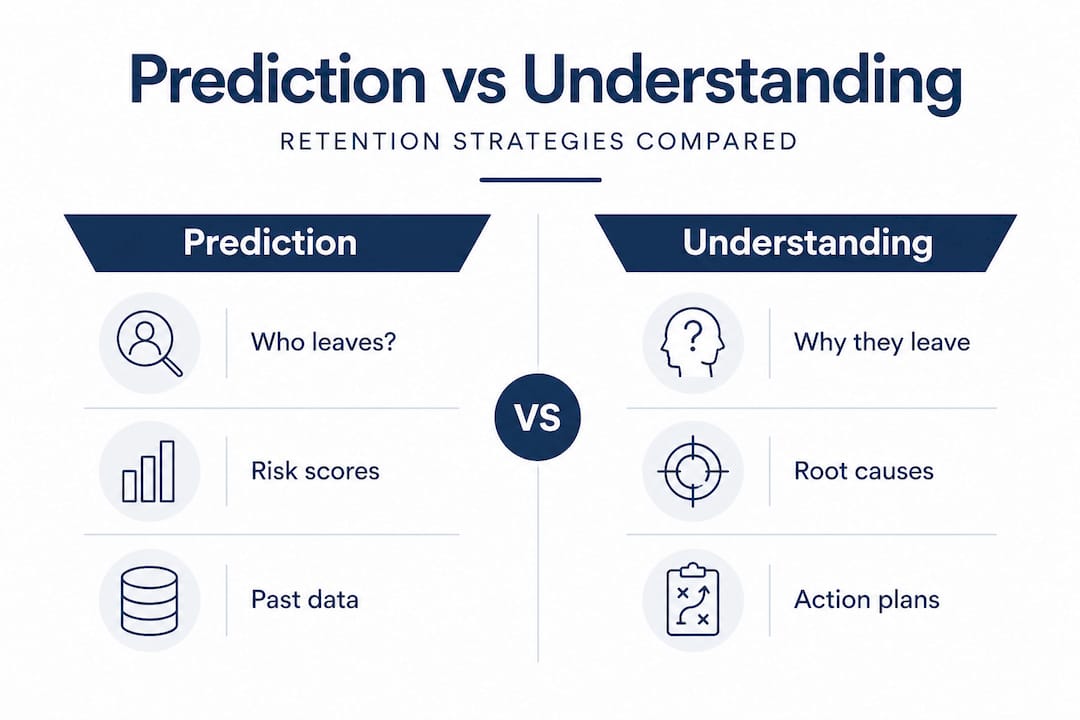
How Predictive Retention Models Work and Where They Fall Short
Predictive retention models usually look for patterns in employee data.
They may consider factors such as tenure, engagement scores, absenteeism, performance trends, manager changes, role changes, or past turnover patterns. The model then estimates which employees may be more likely to leave.
That can be useful.
The problem is that prediction can create false confidence.
A model may tell leaders that someone is at risk, but it may not explain whether the issue is workload, manager alignment, values disconnect, team friction, lack of growth, or something happening outside the workplace.
That matters because the wrong intervention can make the situation worse.
If the real issue is manager friction, a generic career conversation may not help. If the real issue is lack of growth, a wellness perk will not fix it. If the real issue is values misalignment, a pay adjustment may only delay the resignation.
Predictive tools should not replace leadership judgment. They should sharpen it.
The best use of prediction is to help leaders ask better questions earlier.
Pro Tip: Treat a risk score as a signal, not a conclusion. The number tells leaders where to look. Understanding tells them what to do next.

Why Context Matters More Than the Risk Score
Retention risk is personal.
Two employees can look similar in the data but need completely different support.
One may need clearer expectations. Another may need a stronger manager relationship. Another may need a growth path. Another may need relief from unsustainable workload. Another may need better team connection.
This is why context matters.
Leaders need to understand:
-
Whether the employee feels aligned with the work
-
Whether they feel understood by their manager
-
Whether team friction is draining energy
-
Whether their values still fit the company environment
-
Whether they see a future inside the company
-
Whether their strengths are being used
-
Whether workload pressure is becoming unsustainable
-
Whether they feel recognized for the contribution they make
This kind of understanding does not come from a score alone.
It comes from better visibility into the relationship between the employee, manager, team, role, and company direction.
A realistic scenario: two employees are both quiet in meetings and less engaged than before. One is overwhelmed by workload and needs clearer priorities. The other is frustrated because they feel blocked from growth. Same signal. Different cause. Different solution.
The risk score points to the smoke. Context tells leaders where the fire may be.
From Risk Signals to Better Retention Decisions
Prediction becomes useful only when leaders turn it into better action.
A simple retention decision framework can help.
Step 1: Identify the signal
Start by noticing who may need attention. This may come from data, manager concern, engagement changes, stay survey results, or visible shifts in participation.
Step 2: Look for the likely cause
Do not assume the reason. Look for patterns around manager alignment, team friction, workload, values alignment, role fit, growth, recognition, and connection to the company.
Step 3: Ask better questions
Generic check-ins usually produce generic answers. Ask questions that reveal friction and future commitment.
Useful questions include:
-
What feels harder than it should right now?
-
What part of your role feels most aligned?
-
What part feels least aligned?
-
Where do you feel blocked?
-
What kind of support would make your work more sustainable?
-
What would make staying and growing here more valuable?
Step 4: Match the intervention to the cause
Do not use the same retention fix for everyone.
If the issue is growth, clarify the path.
If the issue is manager alignment, improve communication.
If the issue is workload, adjust priorities.
If the issue is team friction, address the tension directly.
If the issue is values misalignment, understand whether the role or environment can realistically change.
Step 5: Follow up
Retention work is not complete because one conversation happened. Leaders need to check whether clarity, trust, connection, and alignment improved.
The goal is not to keep every employee forever. The goal is to reduce avoidable turnover by understanding the risk early enough to act.
Where Leaders Get Retention Wrong
Leaders get retention wrong when they chase prediction without understanding.
They want to know who might leave. That is reasonable. But if they stop there, they are still guessing.
The deeper issue is that most companies do not have enough visibility into why employees are becoming less committed. They do not see manager friction early enough. They do not see values misalignment clearly enough. They do not see team tension until it affects performance. They do not see that a strong employee has stopped seeing a future inside the company.
That is why broad retention programs often fail.
A pay increase does not fix poor manager alignment. A wellness benefit does not fix lack of growth. A team event does not fix values disconnect. A generic engagement survey does not reveal the person who is quietly preparing to leave.
What works is more specific:
-
Understand the reason behind the risk
-
Match action to the actual issue
-
Help managers act before resignation becomes the signal
-
Use data to sharpen human judgment, not replace it
The companies that win retention will not be the ones with the most dashboards. They will be the ones that understand their people well enough to act before the wrong people leave.
How OpenElevator Helps Leaders Understand Retention Risk Earlier
Prediction alone is not enough.
Leaders need to understand where retention risk is forming and why it may be happening.
OpenElevator helps CEOs, founders, senior leaders, and managers detect retention risk, team misalignment, and hidden friction before they become costly resignations. The platform uses a short, bias-complimentary Key Team Stay Survey and a proprietary algorithm to reveal values alignment, interpersonal alignment, and where leaders may need to act earlier.
That means leaders can move beyond guessing who might leave and start understanding what may be driving the risk.
A team can look stable while disengagement, manager-employee misalignment, values disconnect, or hidden friction is already building beneath the surface. OpenElevator helps make those risks easier to see before resignation becomes the first clear signal.
Start with a complimentary Key Team Stay Survey for up to 10 team members and see what may be hidden inside your own team.
Get your complimentary Key Team Stay Survey

Frequently Asked Questions
What is the difference between predicting turnover and understanding retention risk?
Predicting turnover means identifying who may be more likely to leave. Understanding retention risk means identifying why that risk may exist, such as manager friction, values misalignment, team tension, lack of growth, or workload pressure.
Why is prediction alone not enough for employee retention?
Prediction alone is not enough because a risk score does not explain the root cause. Leaders still need to understand what is happening in the employee’s role, manager relationship, team experience, and growth path.
What causes employees to leave even when leaders have predictive data?
Employees may still leave if leaders act on the wrong issue. For example, a pay increase may not help if the real problem is manager misalignment, lack of growth, or feeling disconnected from the company’s values.
How can leaders better understand why employees may leave?
Leaders can better understand retention risk by looking at manager alignment, team friction, values alignment, role fit, workload sustainability, growth clarity, and changes in engagement or participation.
Why do generic retention interventions fail?
Generic interventions fail because employees leave for different reasons. One person may need growth, another may need workload support, another may need better manager alignment, and another may need a stronger connection to the team.
How does OpenElevator go beyond predicting who might leave?
OpenElevator helps leaders detect retention risk, values alignment, interpersonal alignment, and hidden team friction. It gives CEOs, founders, senior leaders, and managers clearer visibility into why risk may be forming.
Is there a free way to try OpenElevator?
Yes. OpenElevator offers a complimentary Key Team Stay Survey for up to 10 team members so leaders can see retention risk, alignment gaps, and hidden friction inside their own team.