Employee turnover costs more than most leaders realize because the damage starts before someone resigns.
By the time an employee leaves, the company may already have lost months of productivity, trust, focus, and momentum. The resignation is only the visible event. The deeper cost often begins earlier, when the employee starts disengaging, withdrawing, losing confidence, or questioning whether they still belong.
Most companies calculate turnover after the person is gone. That is too late.
The real financial risk is not just the cost of replacing someone. It is the hidden cost of missed warning signs: manager-employee friction, team tension, values misalignment, lack of growth, unclear expectations, and quiet disengagement that leaders did not see in time.
This guide explains the true cost of employee turnover, the difference between direct and indirect costs, the hidden impact on productivity and morale, and how leaders can reduce avoidable turnover by seeing risk earlier.
Table of Contents
Key Takeaways
| Point | Details |
|---|---|
| Turnover costs start early | The financial impact often begins before resignation, when engagement and productivity start weakening. |
| Direct costs are only part of the damage | Recruiting, hiring, and training costs are visible, but hidden disruption often costs more. |
| Team morale is affected | When someone leaves, remaining employees may absorb extra work, lose trust, or question their own future. |
| Competitive risk increases | Losing strong people can damage customer relationships, institutional knowledge, and execution speed. |
| Earlier visibility reduces avoidable cost | Leaders need to see retention risk before turnover becomes expensive. |
Defining Employee Turnover And Its True Scope
Employee turnover is the rate at which employees leave a company and are replaced by new employees.
But turnover is not just a workforce metric. It is a business signal.
When the wrong people leave, companies lose knowledge, customer context, execution speed, relationships, and team confidence. The open role is only one part of the problem. The disruption around the role is often the larger cost.
There are two broad types of turnover:
Voluntary turnover happens when an employee chooses to leave.
Involuntary turnover happens when the company ends the employment relationship.
Not all turnover is bad. If someone is consistently underperforming or misaligned with the role, their departure may create room for a stronger fit.
The real problem is avoidable turnover: losing strong employees the company wanted to keep.
That kind of turnover usually does not start on resignation day. It often starts earlier through:
– Manager-employee friction
– Lack of growth
– Values misalignment
– Team tension
– Unclear expectations
– Workload pressure
– Low recognition
– Loss of trust in leadership
– Disconnection from the company’s direction
Most companies assume turnover is a cost they deal with after someone leaves. Stronger leaders treat turnover as a risk to detect before it becomes visible.
Direct Versus Indirect Turnover Costs Explained
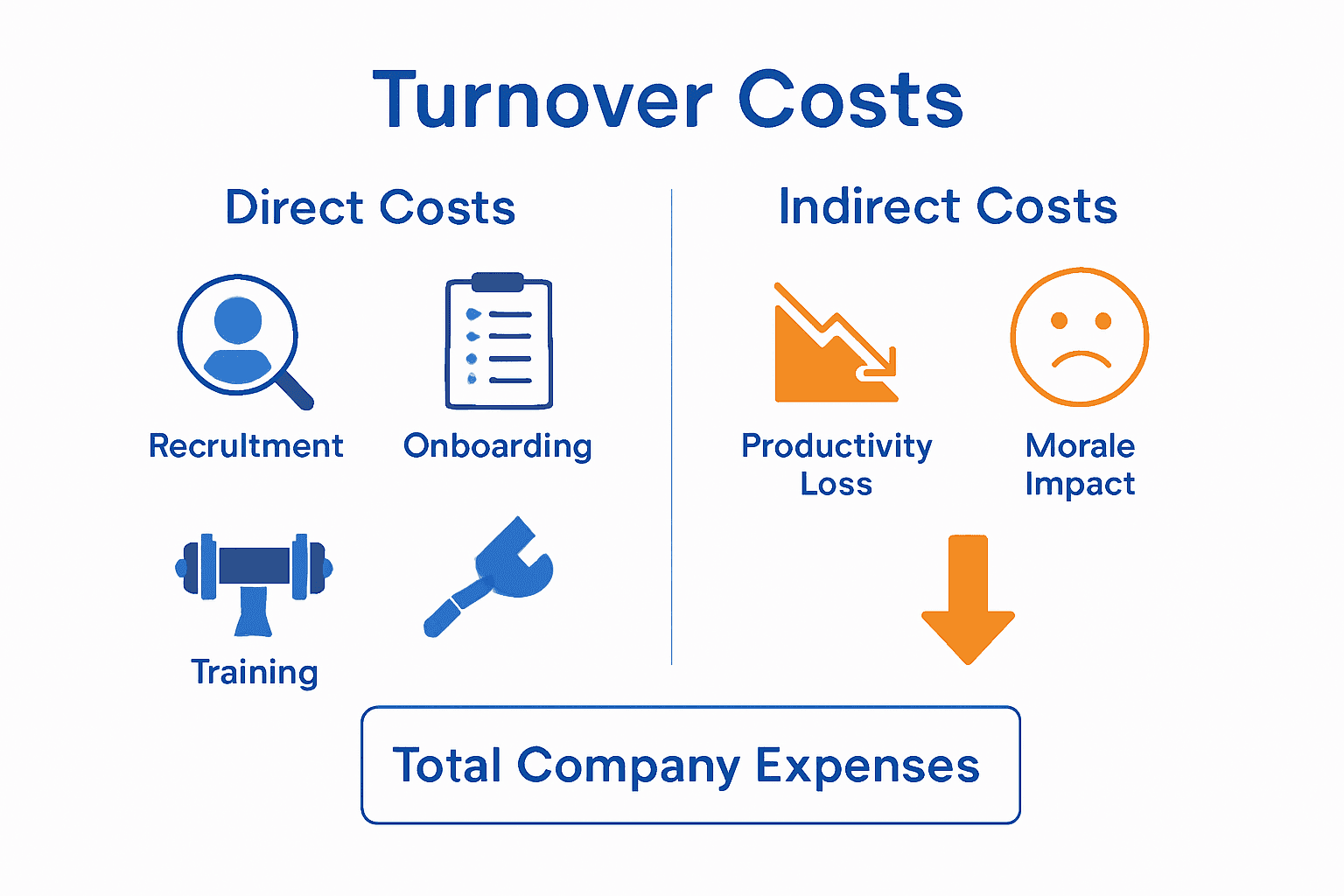
Employee turnover costs fall into two categories: direct costs and indirect costs.
Direct turnover costs are the visible expenses tied to replacing an employee.
They may include:
– Recruiting fees
– Job advertising
– Interview time
– Background checks
– Hiring administration
– Onboarding
– Training
– Temporary coverage
– Lost productivity during ramp-up
These costs are easy to understand because they usually show up in budgets, calendars, and hiring workflows.
Indirect turnover costs are harder to measure, but often more damaging.
They may include:
– Lost institutional knowledge
– Lost customer context
– Delayed projects
– Lower team morale
– Increased workload for remaining employees
– Manager distraction
– Slower decision-making
– Reduced trust in leadership
– Decline in team confidence
– Risk of additional resignations
This is where companies underestimate the cost.
A resignation can create a chain reaction. Remaining employees absorb extra work. Managers spend time recruiting instead of leading. Customers may experience inconsistency. Projects slow down. Team members may begin wondering whether they should leave too.
The better question is not only, “What does it cost to replace this person?”
The better question is:
“What was already costing us before this person resigned?”
Hidden Impacts On Productivity And Team Morale
The hidden cost of turnover often shows up in the team before it shows up in the budget.
When an employee leaves, the remaining team has to adjust. Work gets redistributed. Deadlines shift. Managers become distracted. Team members may lose confidence in the company’s stability or wonder why the person left.
The impact is even greater when the person who leaves was a strong performer, manager, client-facing employee, or informal team anchor.
Hidden impacts can include:
– Lower productivity
– Slower execution
– Increased stress
– Reduced collaboration
– Lower trust
– More mistakes
– Delayed decisions
– Loss of team energy
– Higher risk of burnout
– More pressure on remaining employees
What looks like a single resignation can become a broader retention problem.
A realistic scenario: a high-performing employee resigns after months of quiet frustration. Their manager is surprised. The team is not. Now two employees absorb the extra workload, one key client loses their main contact, and another team member starts looking elsewhere.
The cost was not created by the resignation alone. It was created by the risk leaders did not see earlier.
Financial And Competitive Risks For Businesses
Employee turnover creates financial risk, but it also creates competitive risk.
When strong employees leave, they take more than skills. They take context, judgment, customer knowledge, internal relationships, and momentum. Competitors may gain talent while your company loses execution speed.
The risk is highest when turnover affects people who carry:
– Customer relationships
– Sales pipeline knowledge
– Technical expertise
– Manager credibility
– Institutional memory
– Operational know-how
– Team trust
– Strategic context
Financial risks include hiring costs, productivity loss, training time, and manager distraction.
Competitive risks include slower delivery, weaker customer continuity, reduced innovation, lower morale, and vulnerability to additional departures.
Most companies focus on the replacement cost because it is easier to calculate. But the larger business question is whether turnover is weakening the company’s ability to execute.
Leaders should ask:
– Which employees would create the most disruption if they left?
– Where are we most dependent on one person’s knowledge?
– Which teams look stable but may be under strain?
– Where would a resignation affect customers or revenue?
– What risks are we only seeing after people leave?
Turnover becomes less expensive when leaders see risk before it damages performance.
Strategies To Minimize Turnover-Related Expenses
The best way to reduce turnover-related expenses is to prevent avoidable turnover earlier.
That does not mean trying to keep every employee forever. It means identifying which strong employees may be at risk and addressing the issues that could cause them to leave.
Strong retention strategies include:
– Identifying retention risk before resignation
– Improving manager-employee alignment
– Addressing team friction early
– Clarifying expectations
– Creating personalized growth paths
– Recognizing meaningful contribution
– Supporting workload sustainability
– Reviewing values alignment
– Strengthening onboarding
– Acting quickly on employee feedback
Many companies wait until exit interviews to understand what went wrong. That is a poor strategy because exit interviews explain the loss after the damage is done.
Leaders need earlier signals.
Ask:
– Who may be quietly disengaging?
– Where is manager friction affecting commitment?
– Which employees feel blocked from growth?
– Where is team tension being ignored?
– Who would be difficult or expensive to replace?
– What should we know now that we usually learn too late?
Reducing turnover costs is not just about hiring better. It is about seeing risk earlier and acting before resignation becomes the only signal.
See Turnover Cost Before It Becomes a Resignation
Employee turnover costs are highest when leaders see the risk too late.
A team can look stable while disengagement, manager-employee misalignment, values disconnect, or hidden friction is already building beneath the surface. By the time someone resigns, the company is usually reacting to a problem that started much earlier.
OpenElevator helps CEOs, founders, senior leaders, and managers detect retention risk, team misalignment, and hidden friction before they become costly resignations. The platform uses a short, bias-free team scan and a proprietary algorithm to reveal where leaders may need to act earlier.
Start with a free team scan for up to 10 team members and see what may be hidden inside your own team.

Frequently Asked Questions
What are employee turnover costs?
Employee turnover costs are the direct and indirect expenses created when employees leave and must be replaced. These costs can include recruiting, hiring, onboarding, training, productivity loss, lost knowledge, team disruption, and manager distraction.
Why is employee turnover costly?
Employee turnover is costly because companies lose more than one employee. They may lose institutional knowledge, customer context, team stability, productivity, and execution speed. The remaining team may also carry extra workload.
What are direct turnover costs?
Direct turnover costs include recruiting, job advertising, interviewing, background checks, onboarding, training, temporary coverage, and the time required for a new employee to become productive.
What are indirect turnover costs?
Indirect turnover costs include lost productivity, lower morale, team disruption, lost customer knowledge, manager distraction, delayed projects, increased workload for remaining employees, and higher risk of additional resignations.
How does turnover affect team morale?
Turnover can affect team morale by increasing workload, creating uncertainty, reducing trust, and making employees question the company’s stability. If the person who leaves was highly valued, the emotional impact can be significant.
How can leaders reduce turnover-related expenses?
Leaders can reduce turnover-related expenses by identifying retention risk earlier, improving manager-employee alignment, addressing team friction, creating growth paths, clarifying expectations, and acting on signs of disengagement before employees resign.
How does OpenElevator help reduce turnover costs?
OpenElevator helps leaders detect retention risk, team misalignment, and hidden friction before they become costly resignations. It gives CEOs, founders, senior leaders, and managers clearer visibility into where they may need to act earlier.
Is there a free way to try OpenElevator?
Yes. OpenElevator offers a free team scan for up to 10 team members so leaders can see retention risk, alignment gaps, and hidden friction inside their own team.