A strong onboarding process does more than welcome new hires. It helps leaders reduce early turnover before it starts.
Early turnover often begins when a new employee feels unclear, unsupported, disconnected from the team, misaligned with the manager, or unsure whether the role matches what they expected.
The problem is that these risks can stay hidden. A new hire may attend meetings, complete training, and say things are fine while quietly questioning whether they made the right decision.
That is why onboarding should not be treated as paperwork, orientation, or a checklist. It should be treated as an early retention system.
This guide explains how to build an onboarding process that creates clarity, strengthens manager alignment, improves engagement, and helps leaders spot early retention risk before it becomes resignation.
Table of Contents
Quick Summary
| Main Point | Explanation |
|---|---|
| Onboarding is early retention work | A strong onboarding process helps reduce early turnover by creating clarity, support, and connection. |
| Role clarity matters fast | New hires need to understand expectations, priorities, success measures, and how decisions are made. |
| Manager alignment is critical | The manager relationship often determines whether a new hire feels supported or starts disengaging. |
| Feedback should happen early | Leaders need to ask what feels unclear, misaligned, or harder than expected before frustration builds. |
| Retention data should guide action | Onboarding should help leaders see where new hire risk is forming before resignation happens. |
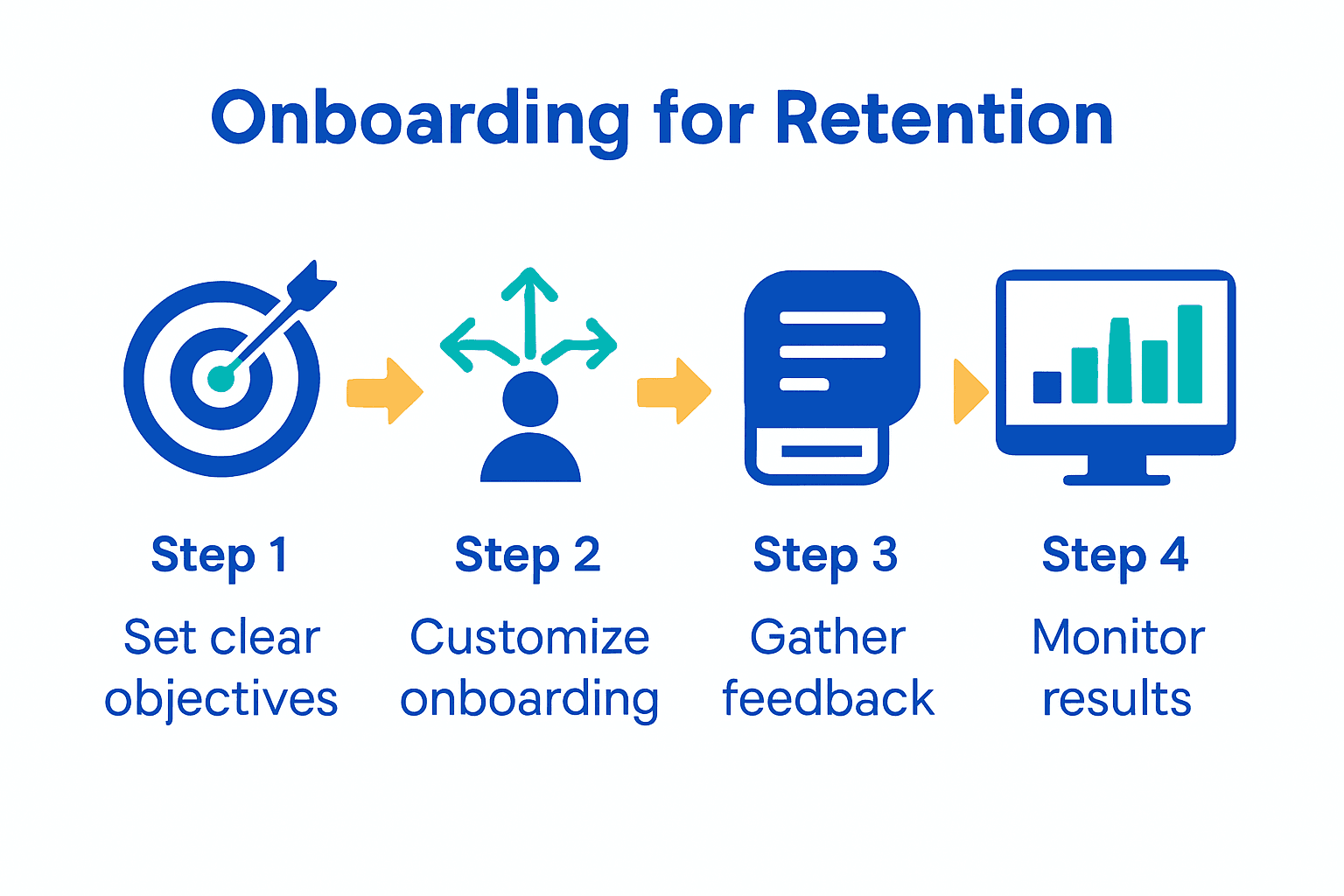
Step 1: Define onboarding objectives and success criteria
The first step in an effective onboarding process is defining what success should look like.
Too many companies treat onboarding as complete once paperwork is done, systems are set up, and the new hire has met the team. That is too shallow.
Onboarding should help answer:
– Does the new hire understand the role?
– Do they know what success looks like?
– Are priorities clear?
– Do they feel supported by their manager?
– Are they connecting with the team?
– Does the role match what they expected?
– Are there signs of confusion, friction, or misalignment?
Clear onboarding objectives should include:
– Role clarity
– Manager alignment
– Team connection
– Cultural understanding
– Early confidence
– Skill development
– Feedback rhythm
– Retention risk visibility
The goal is not just to help someone start. The goal is to help them become confident, connected, and more likely to stay.
Step 2: Customize onboarding flows for critical roles
Not every role needs the same onboarding process.
A sales leader, customer success manager, operations hire, engineer, and front-line supervisor may all need different levels of context, training, mentorship, and manager support.
Generic onboarding creates risk because it assumes every new hire needs the same thing. Critical roles need more precision.
Customize onboarding based on:
– Role complexity
– Customer exposure
– Technical skill requirements
– Leadership responsibility
– Cross-functional dependencies
– Team dynamics
– Ramp-up timeline
– Risk if the person leaves early
A realistic scenario: a new manager joins and completes standard onboarding, but no one clarifies decision authority, team history, or internal friction. They appear fine for the first month, but they are already unsure how to succeed. By month three, the risk is visible.
Custom onboarding should help leaders see that risk earlier.
For critical roles, add specific checkpoints around expectations, manager fit, team connection, and role alignment.

Step 3: Develop engagement-driven onboarding materials
Onboarding materials should do more than explain policies.
They should help the new hire understand the company, the role, the team, and what it will take to succeed.
Strong onboarding materials include:
– First-week schedule
– Role expectations
– Success measures
– Team structure
– Key contacts
– Communication norms
– Decision-making expectations
– Tools and systems
– Cultural norms
– Growth path context
But materials alone do not create engagement.
Engagement comes from feeling seen, supported, and connected. That means onboarding materials should be paired with real conversations from the manager and team.
Avoid dumping too much information at once. Too much onboarding content can create confusion instead of clarity.
The better question is not, “Did we give the new hire everything?”
The better question is:
“Does the new hire understand what matters most and where to go for support?”
Step 4: Implement feedback loops and rapid support measures
Feedback loops are where onboarding becomes a retention system.
New hires often avoid raising concerns because they want to make a good impression. They may not admit they feel confused, disconnected, or disappointed with the role.
That is why leaders need to ask early and often.
Use check-ins at:
– End of week one
– End of week two
– 30 days
– 60 days
– 90 days
Ask questions such as:
– What feels clear so far?
– What feels different than expected?
– Where do you need more support?
– What is harder than it should be?
– Do you feel connected to your manager and team?
– What would make the next month easier?
– Is anything making you question whether this role is the right fit?
These questions expose risk before it becomes resignation.
Rapid support matters. If a new hire raises a concern and nothing changes, trust drops quickly. Leaders should act on early friction while the relationship is still forming.
Step 5: Monitor onboarding effectiveness and retention data
Onboarding should be measured by more than completion.
A completed checklist does not mean the new hire is confident, connected, or likely to stay.
Monitor whether onboarding is actually working by tracking:
– Role clarity
– Manager alignment
– Team connection
– Early engagement
– Training progress
– Confidence level
– Support needs
– Signs of friction
– New hire turnover
– 30, 60, and 90-day feedback
The most important signal is whether the new hire is becoming more aligned over time.
If someone still feels unclear after 30 days, disconnected after 60 days, or unsupported after 90 days, the company may already be creating avoidable turnover risk.
Do not wait until a new hire leaves to ask what went wrong.
Use onboarding data to identify risk early, support managers better, and improve the process before another strong hire disengages.
See Onboarding Risk Before It Becomes Early Turnover
Onboarding can look complete while retention risk is already forming.
A new hire may have completed training, met the team, and started contributing while still feeling unclear, unsupported, misaligned with the manager, or disconnected from the company.
OpenElevator helps CEOs, founders, senior leaders, and managers detect retention risk, team misalignment, and hidden friction before they become costly resignations. The platform uses a short, bias-complimentary Key Team Stay Survey and a proprietary algorithm to reveal where leaders may need to act earlier.
Start with a complimentary Key Team Stay Survey for up to 10 team members and see what may be hidden inside your own team.
Get your complimentary Key Team Stay Survey

Frequently Asked Questions
What is an onboarding process?
An onboarding process is the structured experience that helps a new employee move from accepted offer to confident contributor. It includes role clarity, manager support, team connection, cultural understanding, training, and feedback.
Why does onboarding affect employee retention?
Onboarding affects retention because early confusion, weak manager alignment, team disconnection, unclear expectations, or role mismatch can cause new hires to disengage before leaders realize there is a problem.
What are the key steps in an onboarding process?
The key steps include defining onboarding objectives, customizing onboarding for important roles, creating useful onboarding materials, building feedback loops, and monitoring onboarding effectiveness through retention and engagement signals.
How can leaders reduce turnover through onboarding?
Leaders can reduce turnover through onboarding by clarifying expectations, strengthening manager alignment, creating team connection, checking for early friction, and acting quickly when new hires feel unsupported or misaligned.
What should managers ask during onboarding check-ins?
Managers should ask what feels clear, what feels confusing, what is harder than expected, where the new hire needs support, whether the role matches expectations, and whether anything is making them question the fit.
How should companies measure onboarding effectiveness?
Companies should measure onboarding effectiveness by tracking role clarity, manager alignment, team connection, early engagement, training progress, support needs, new hire feedback, and early turnover patterns.
How does OpenElevator help with onboarding and retention?
OpenElevator helps leaders detect retention risk, team misalignment, and hidden friction before they become costly resignations. It gives CEOs, founders, senior leaders, and managers clearer visibility into where new hires or existing employees may need earlier support.
Is there a free way to try OpenElevator?
Yes. OpenElevator offers a complimentary Key Team Stay Survey for up to 10 team members so leaders can see retention risk, alignment gaps, and hidden friction inside their own team.