
More than 40 percent of American tech companies struggle with consistently high employee turnover, costing billions every year. For C-level executives, retaining skilled talent is not just a matter of productivity but a complex challenge that shapes stability, growth, and culture. This article breaks down what employee retention truly means in a modern workplace, clarifying the drivers that keep your workforce engaged and committed for the long haul.
Table of Contents
- Defining Employee Retention In The Workplace
- Types Of Employee Retention And Core Drivers
- How Values And Interpersonal Alignment Influence Tenure
- Essential Strategies For Long-Term Engagement
- Common Mistakes That Undermine Retention
Key Takeaways
| Point | Details |
|---|---|
| Employee Retention is Strategic | It focuses on creating an environment where employees feel valued and engaged. This helps reduce turnover rates and foster workplace stability. |
| Understanding Individual Needs is Key | Tailor retention strategies to meet the unique aspirations and motivations of employees across diverse demographics. |
| Value Alignment and Relationships Matter | Employees are more likely to stay when their personal values align with the organization’s and they have strong relationships with their leaders. |
| Mistakes Can Undermine Efforts | Organizations often fail by neglecting employee development and transparency, which erodes trust and engagement over time. |
Defining Employee Retention In The Workplace
Employee retention represents an organization’s strategic ability to keep talented workers engaged and committed to their roles over time. At its core, retention is about creating workplace environments where employees feel valued, supported, and motivated to contribute their best work. Organizational cultures that prioritize employee development and satisfaction play a crucial role in reducing voluntary turnover and maintaining workforce stability.
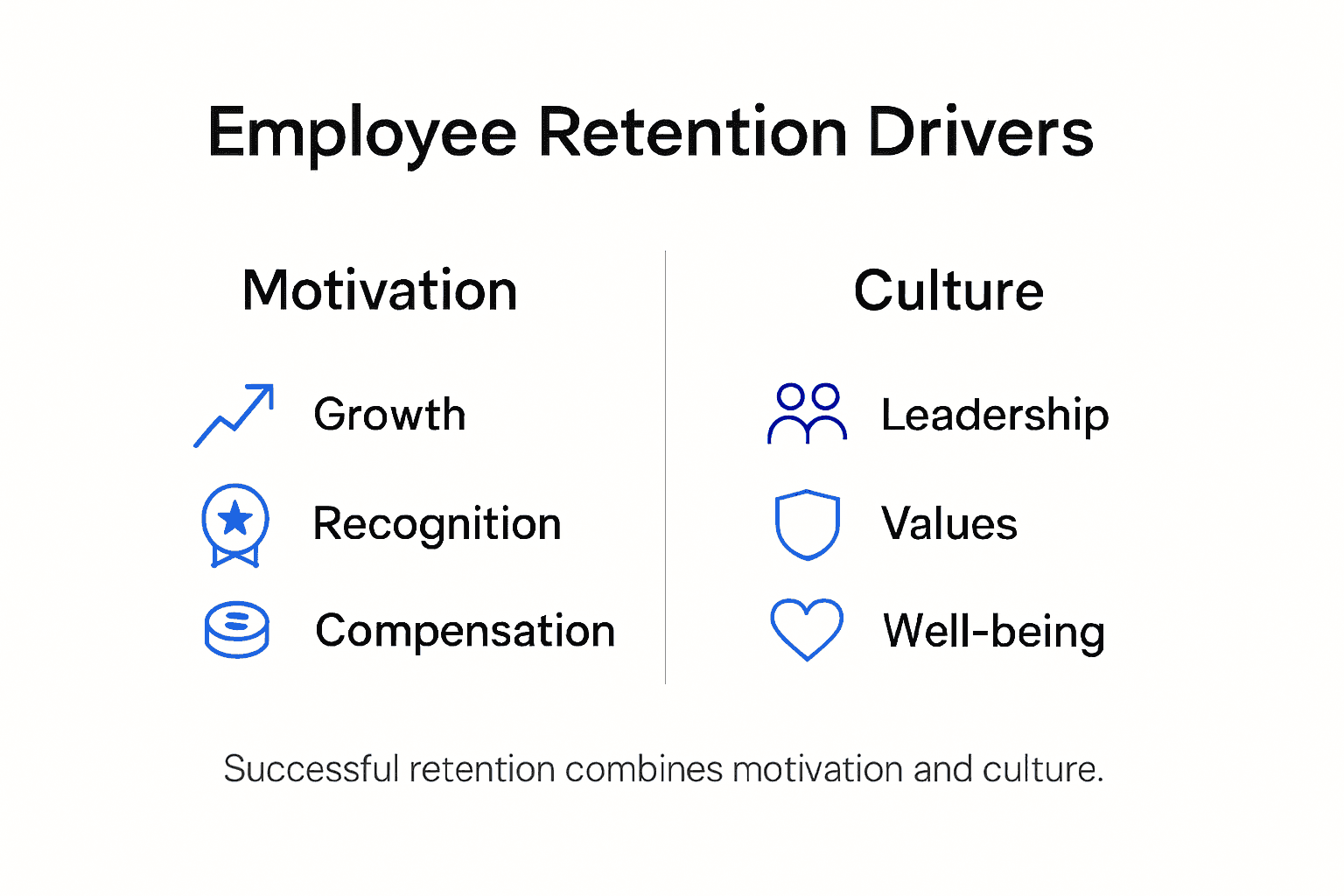
The Work Institute’s 2023 Retention Report highlights that retention is far more complex than simply preventing employees from leaving. It involves understanding the multifaceted needs of workers across different demographics and creating comprehensive strategies that address those needs. Key factors influencing retention include professional growth opportunities, competitive compensation, meaningful recognition, work-life balance, and strong leadership relationships.
Successful employee retention strategies go beyond traditional HR approaches. They require a holistic understanding of human motivation and organizational culture. Employers must recognize that each employee has unique expectations and drivers. This means developing personalized engagement approaches that consider individual career aspirations, learning preferences, and personal values. By treating retention as a dynamic, ongoing process rather than a static metric, organizations can create environments where top talent naturally wants to remain and grow.
Pro Tip: Conduct regular one-on-one conversations with team members to understand their individual career goals and potential obstacles to their satisfaction.
Types Of Employee Retention And Core Drivers
Employee retention is a nuanced concept with multiple dimensions, extending far beyond simple workforce stability. Researchers have identified distinct types of turnover that provide critical insights into organizational dynamics, including voluntary and involuntary retention patterns. Voluntary retention occurs when employees actively choose to stay with an organization, while involuntary retention involves external factors compelling workers to remain in their current roles.
Core drivers of employee retention are multifaceted and deeply interconnected. They encompass critical elements such as competitive compensation, meaningful work experiences, professional development opportunities, and positive organizational culture. The International Journal of Research in Human Resource Management highlights that retention strategies must be tailored to specific organizational contexts, considering factors like company size, generational workforce composition, and industry-specific challenges.

Understanding retention requires examining both functional and dysfunctional turnover. Functional turnover involves the strategic departure of lower-performing employees, potentially benefiting organizational performance. Conversely, dysfunctional turnover represents the loss of high-performing talent that can significantly disrupt team dynamics and institutional knowledge. Modern retention strategies must therefore focus not just on keeping employees, but on cultivating environments where top talent naturally wants to remain and grow.
Here’s how different types of employee retention and turnover compare:
| Type | Definition | Typical Impact on Organization |
|---|---|---|
| Voluntary Retention | Employee chooses to stay | Boosts morale and stability |
| Involuntary Retention | External factors force staying | May lower engagement and innovation |
| Functional Turnover | Loss of low performers | Can improve team effectiveness |
| Dysfunctional Turnover | Loss of top performers | Harms productivity and knowledge |
Pro Tip: Develop personalized retention plans that recognize individual employee motivations and career aspirations, moving beyond one-size-fits-all approaches.
How Values And Interpersonal Alignment Influence Tenure
Value alignment represents the critical intersection between an individual’s personal beliefs and an organization’s core principles. Research reveals that employees are significantly more likely to remain with organizations where their fundamental values closely match the company’s cultural framework, creating a profound sense of professional belonging and purpose.
Interpersonal dynamics play an equally crucial role in employee tenure. Supervisors who demonstrate genuine understanding, respect, and support can transform workplace relationships from transactional interactions to meaningful connections. The Harvard Business Review highlights that employees who experience strong, trust-based relationships with their immediate leaders are more prone to long-term commitment, viewing their roles not just as jobs but as integral parts of their professional journey.
The complexity of value and interpersonal alignment extends beyond simple compatibility. It encompasses deeper psychological needs such as feeling respected, understood, and empowered. Employees seek environments where their individual contributions are recognized, their professional aspirations are supported, and their personal growth is viewed as a mutual organizational objective. When these nuanced elements converge, they create powerful retention mechanisms that transcend traditional compensation and benefits strategies.
Pro Tip: Conduct regular, structured conversations with team members that explore their personal values, career goals, and perceived alignment with organizational mission.
Essential Strategies For Long-Term Engagement
Comprehensive research on employee engagement strategies reveals that successful long-term retention requires a multifaceted approach addressing both individual and organizational needs. Competitive compensation remains fundamental, but modern employees seek more than just financial rewards. They desire meaningful work environments that support professional growth, provide flexibility, and demonstrate genuine commitment to their personal and professional development.
Organizational commitment goes beyond traditional performance management. The most effective strategies focus on creating supportive ecosystems that address employees’ psychological needs for belonging, recognition, and purpose. This involves developing robust professional development programs, implementing transparent communication channels, and designing flexible work arrangements that accommodate diverse personal circumstances. Leaders must view engagement as a dynamic, ongoing process of mutual investment rather than a static set of transactional interactions.
The complexity of long-term engagement demands a holistic approach. Successful organizations recognize that retention strategies must be adaptive, personalized, and responsive to changing workforce dynamics. This means continuously reassessing organizational culture, providing meaningful feedback mechanisms, and creating opportunities for employees to contribute beyond their immediate job responsibilities. By treating employees as valued partners in organizational success, companies can transform retention from a human resources challenge into a strategic competitive advantage.
Summary of key strategies for fostering long-term employee engagement:
| Strategy Element | Purpose | Example Implementation |
|---|---|---|
| Professional Growth | Encourage skill development | Mentorship programs and training |
| Recognition | Increase motivation | Employee achievement awards |
| Flexibility | Support work-life balance | Remote and hybrid work options |
| Transparent Communication | Build trust and clarity | Regular town hall meetings |
Pro Tip: Implement quarterly individual development conversations that explore both professional aspirations and potential pathways for growth within the organization.
Common Mistakes That Undermine Retention
Research from leading organizational experts reveals that companies often sabotage their retention efforts through predictable yet avoidable mistakes. Organizational blindness emerges as a primary culprit, where leadership fails to recognize the subtle yet critical factors driving employee disengagement. These mistakes are rarely dramatic failures, but instead represent a series of small, cumulative missteps that gradually erode workforce commitment.
One fundamental error involves treating employee development as an afterthought rather than a strategic priority. Organizations frequently underinvest in professional growth opportunities, assuming that competitive salary alone will secure talent loyalty. This approach neglects the deeper psychological needs of modern professionals who seek meaningful work, clear career pathways, and continuous learning environments. When employees perceive their personal development as stagnant, they begin exploring opportunities elsewhere, often without signaling their growing disengagement.
Transparency and communication represent another critical area where organizations consistently undermine retention. Leaders who withhold information, provide inconsistent messaging, or fail to create psychologically safe environments inadvertently cultivate uncertainty and mistrust. Employees need consistent, honest communication about organizational challenges, potential changes, and their individual roles within the broader strategic landscape. The absence of such transparency transforms workplace relationships from collaborative partnerships into transactional, disposable interactions.
Pro Tip: Implement monthly transparent communication sessions where leadership shares organizational challenges and actively solicits employee feedback and perspectives.
Unlock The Secret To Lasting Employee Retention With OpenElevator
The article highlights a key challenge every organization faces employee retention is about more than just competitive pay it hinges on understanding values alignment and interpersonal connections. When companies fail to recognize these often invisible but critical factors they risk losing top talent and weakening team dynamics. The pain points of disengagement and unpredictable turnover can feel overwhelming but there is a proven way to transform this complex problem into a strategic advantage.
OpenElevator is the only platform that uses a proprietary algorithm to reveal exactly who is at risk of quitting by measuring values alignment and interpersonal fit based on a quick 5-minute unbiased survey. This deep insight allows leaders to take targeted action before turnover impacts performance. Through OpenElevator’s innovative platform, you gain clarity and control over employee retention by uncovering how well your workforce’s basic human needs for safety growth contribution and connection are met. Experience retention strategies that work for organizations from startups to Fortune 500 companies.
Take control of your retention challenges right now and stop guessing who might leave. Visit OpenElevator to discover how our platform can identify high-risk employees and boost engagement with data-driven solutions. Start building stronger teams today by knowing exactly what matters most to your people and fostering long-term commitment.
Frequently Asked Questions
What factors contribute to employee retention in the workplace?
Key factors include professional growth opportunities, competitive compensation, meaningful recognition, work-life balance, and strong leadership relationships.
How can organizations create an environment that promotes employee retention?
Organizations can foster retention by developing personalized engagement strategies, encouraging open communication, providing professional development, and ensuring alignment between employee values and company culture.
What are the different types of employee turnover, and why do they matter?
Employee turnover includes voluntary turnover, where employees choose to leave, and involuntary turnover, which occurs due to external factors. Understanding these types helps organizations address retention issues more effectively.
What strategies can improve long-term employee engagement?
Successful strategies include offering competitive compensation, creating flexible work arrangements, recognizing employee achievements, and maintaining transparent communication within the organization.