Employee turnover can quickly disrupt productivity, drain knowledge, and weaken team cohesion across American tech organizations. For C-level leaders, understanding turnover risk and retention signals is crucial because voluntary exits rarely occur without warning and often result from complex workplace dynamics. This article unpacks actionable strategies that empower managers to anticipate risk, interpret signs of disengagement, and implement targeted interventions for stronger teams and lasting retention.
Table of Contents
- Defining Turnover Risk And Retention Signals
- Types Of Turnover Risk And Underlying Causes
- Early Warning Signs Of Disengagement
- Costs And Impacts On Team Dynamics
- Proactive Approaches To Mitigate Turnover
Key Takeaways
| Point | Details |
|---|---|
| Understanding Turnover Risk | Organizations should focus on identifying turnover risk through predictive analytics and employee engagement factors to prevent attrition before it happens. |
| Types of Turnover | Recognizing different turnover types (voluntary, involuntary, etc.) allows for tailored retention strategies that address specific organizational challenges. |
| Signs of Disengagement | Monitoring early warning signs of disengagement enables proactive leadership to intervene before employees decide to leave. |
| Proactive Mitigation Strategies | Employers should implement multifaceted retention strategies, including analytics, mentorship, and transparent communication, to foster loyalty and minimize turnover costs. |
Defining turnover risk and retention signals
Turnover risk represents the statistical probability that employees will voluntarily exit an organization within a specific timeframe. Unlike traditional metrics that merely track departures after they occur, modern approaches focus on predicting and preventing employee attrition through sophisticated predictive analytics.
Understanding turnover risk requires examining multiple interconnected factors that signal potential workforce disruption. These signals typically include:
- Job satisfaction levels and engagement metrics
- Career development opportunities
- Compensation alignment with market standards
- Work-life balance perceptions
- Team dynamics and interpersonal relationships
- Individual performance trajectory
Research indicates that voluntary turnover is rarely a sudden event, but instead a gradual process driven by complex organizational and personal dynamics. Organizational attachment patterns play a critical role in predicting employee retention, revealing that workers assess their commitment through multifaceted lenses beyond simple salary considerations.

Managerial teams must develop nuanced approaches to interpreting these retention signals. This means moving beyond surface-level metrics to understand the underlying psychological and professional motivations driving workforce decisions. Effective retention strategies require continuous monitoring, proactive engagement, and personalized intervention strategies.
Pro tip: Implement quarterly confidential pulse surveys to capture real-time sentiment and identify potential retention risks before they escalate into actual turnover events.
Types of turnover risk and underlying causes
Organizations experience multiple categories of workforce turnover, each with distinct implications for organizational health. Turnover classifications range from internal versus external movements to voluntary and involuntary separations, creating a complex landscape of potential workforce disruptions.
The primary types of turnover include:
- Voluntary turnover: Employees actively choose to leave the organization
- Involuntary turnover: Terminations initiated by the employer
- Functional turnover: Departure of low-performing employees
- Dysfunctional turnover: Loss of high-performing or critical talent
- Internal turnover: Employees moving between departments or roles
- External turnover: Complete separation from the organization
Comprehensive research on turnover causes reveals a multifaceted origin involving personal, organizational, and broader economic factors. These underlying causes can be systematically categorized into three primary domains:
- Personal Factors
- Individual career aspirations
- Personal life circumstances
- Professional skill development goals
- Psychological engagement with work
- Organizational Factors
- Compensation structures
- Management quality
- Career advancement opportunities
- Workplace culture and environment
- External Economic Factors
- Job market conditions
- Industry-specific trends
- Economic stability
- Competitive job market dynamics
Understanding these nuanced turnover types allows organizations to develop targeted retention strategies that address specific workforce challenges and minimize potential talent losses.
Here is a summary comparing different types of turnover and their typical impacts on organizations:
| Turnover Type | Main Driver | Key Risk | Typical Impact |
|---|---|---|---|
| Voluntary | Employee decision | Talent loss | Potential knowledge drain |
| Involuntary | Employer decision | Morale decrease | Disrupted teamwork |
| Functional | Low performer exit | Transition management | Opportunity for upskilling |
| Dysfunctional | High performer exit | Strategic capability gap | Increased recruitment urgency |
| Internal | Department transfer | Team imbalance | Requires rapid onboarding |
| External | Organization separation | Brand perception risk | Higher hiring cost |
Pro tip: Conduct periodic exit interviews across different turnover categories to systematically understand and address underlying motivational patterns driving employee departures.
Early warning signs of disengagement
Employee disengagement is a subtle yet destructive force that can silently erode organizational performance long before an actual resignation occurs. Early indicators of workplace disengagement reveal complex psychological and behavioral patterns that signal potential workforce challenges.
Key behavioral warning signs include:
- Decreased productivity and work quality
- Consistent missed deadlines
- Reduced communication with team members
- Visible negative attitude or emotional withdrawal
- Minimal participation in team activities
- Increased absenteeism or frequent tardiness
- Lack of initiative or creative problem-solving
Psychological markers of disengagement extend beyond observable behaviors, revealing deeper organizational disconnection. These subtle signals often manifest as:
- Emotional detachment
- Reduced interpersonal enthusiasm
- Minimal discretionary effort
- Persistent cynicism about organizational goals
Leadership plays a critical role in detecting and addressing these warning signs before they escalate into full-blown turnover risks. Proactive managers understand that disengagement is not a binary state but a gradual process requiring nuanced, empathetic intervention.
Pro tip: Implement monthly one-on-one check-ins using structured conversation guides to identify subtle disengagement signals before they become entrenched behavioral patterns.
Costs and impacts on team dynamics
Workforce turnover represents far more than a simple personnel replacement challenge. Organizational performance consequences extend deep into team productivity, morale, and strategic capabilities, creating ripple effects that can destabilize entire departments.
The financial and operational impacts of high turnover include:
- Direct recruitment expenses
- Training and onboarding costs
- Lost institutional knowledge
- Reduced team productivity
- Increased error rates
- Disrupted workflow continuity
- Lowered team morale
- Potential client relationship damage
Team dynamics transformation occurs through multiple interconnected mechanisms. When experienced team members depart, remaining employees experience increased stress, reduced trust, and diminished collaborative capacity. This psychological strain manifests as:
- Increased individual workload
- Reduced team cohesion
- Decreased communication effectiveness
- Higher performance anxiety
The compounding effect of repeated turnover can trigger a destructive cycle where ongoing instability prevents teams from achieving sustained performance levels. High-performing organizations recognize that team dynamics represent a complex ecosystem requiring careful, proactive management.
Pro tip: Develop comprehensive knowledge transfer protocols that capture critical institutional insights before employee departures, minimizing disruption and preserving organizational intelligence.
Proactive approaches to mitigate turnover
Addressing workforce turnover requires a strategic, multifaceted approach that goes beyond traditional retention tactics. Strategic retention practices demand comprehensive, data-driven interventions tailored to an organization’s unique workforce dynamics.
Effective proactive strategies encompass several critical domains:
- Early detection of potential turnover risks
- Personalized career development pathways
- Continuous feedback and engagement mechanisms
- Competitive compensation and benefits design
- Organizational culture enhancement
- Professional growth and skill development opportunities
- Leadership communication and transparency
Comprehensive workforce retention involves implementing targeted initiatives that address systemic challenges and individual employee needs. Organizations can achieve this through:
- Advanced workforce analytics tracking
- Mentorship and career advancement programs
- Regular employee sentiment assessments
- Flexible work arrangement options
- Transparent performance management
Successful mitigation strategies recognize that turnover is not a singular event but a complex interaction of organizational culture, individual aspirations, and systemic support mechanisms. The most effective approaches blend data-driven insights with human-centered interventions.
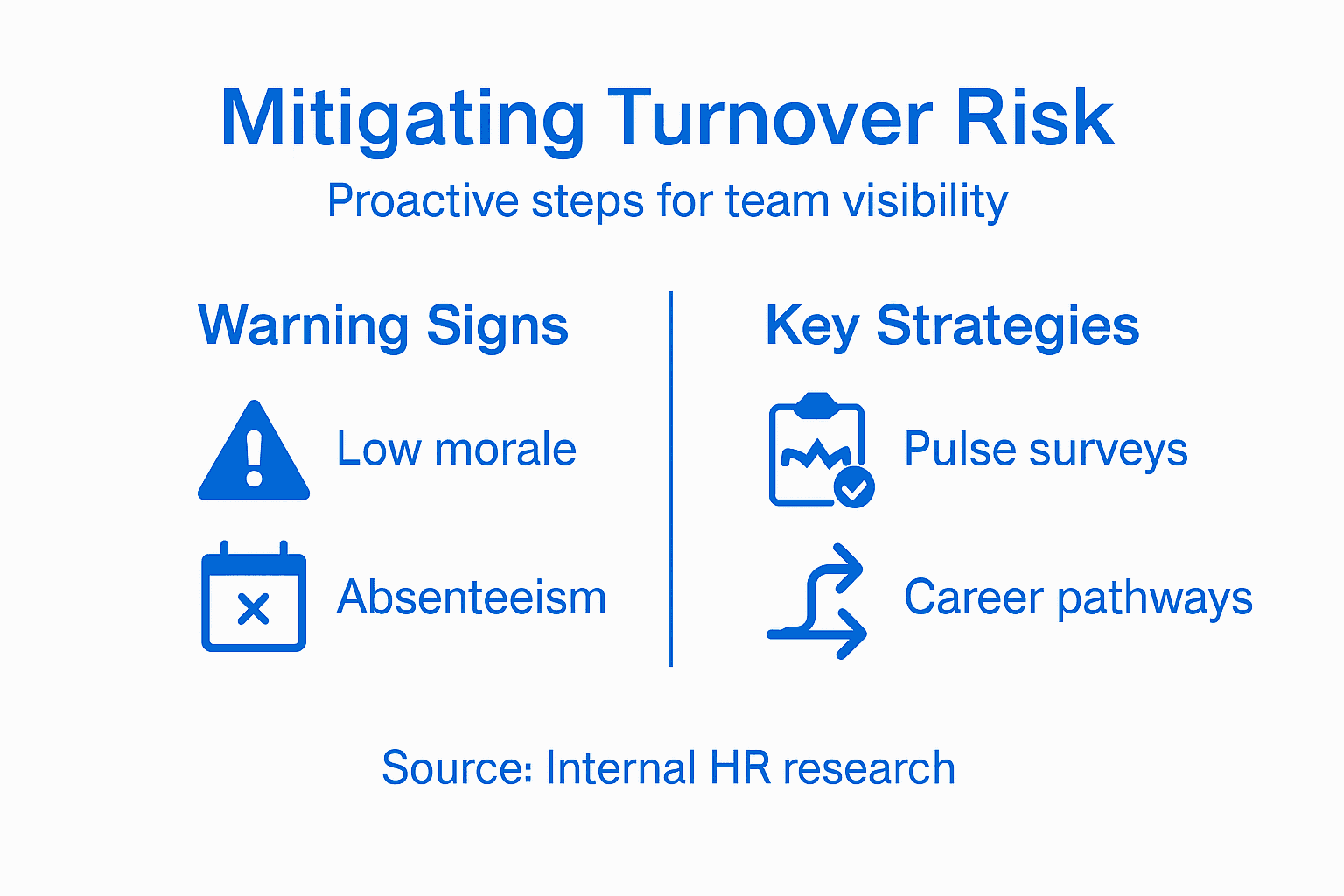
The following table highlights practical interventions for mitigating turnover risks and their intended business outcomes:
| Intervention Strategy | Core Approach | Expected Outcome |
|---|---|---|
| Advanced analytics | Predictive data modeling | Early-risk identification |
| Structured mentorship | Formal development plans | Enhanced employee loyalty |
| Flexible work arrangements | Remote/hybrid scheduling | Higher job satisfaction |
| Sentiment assessments | Regular employee surveys | Actionable workforce insights |
| Transparent communication | Leadership updates and feedback | Improved organizational trust |
Pro tip: Create individualized career development roadmaps that align employee personal growth objectives with organizational strategic goals, transforming retention from a reactive to a proactive process.
Gain True Visibility Into Your Team’s Turnover Risk Before It Escalates
The article highlights a critical challenge leaders face today: turnover risk builds quietly within teams long before resignations occur. Key pain points such as disengagement, subtle warning signs, and the need for early detection reveal how retention is often a lagging indicator. Without clear visibility into factors like team dynamics and individual sentiment, leaders rely on instinct or post-exit explanations that come too late to salvage valuable talent.
OpenElevator directly addresses these challenges by providing quantifiable, actionable insight into retention signals and turnover risks. Instead of waiting for problems to surface, you can monitor real-time indicators like employee engagement and fit within your team. This proactive visibility empowers you to intervene with precision and confidence, improving both retention and hiring success.
See how OpenElevator transforms employee experience into defensible insight today.
Take charge of your team’s future now by exploring how our platform reveals hidden turnover risks and optimizes team dynamics. Visit OpenElevator to learn more and start leading with clarity and confidence. For a deeper dive into proactive team visibility and retention, check out Turnover Risk Explained: Proactive Team Visibility and begin turning insight into impact.
Frequently Asked Questions
What is turnover risk?
Turnover risk refers to the probability that employees will voluntarily leave an organization within a specific timeframe, driven by various factors such as job satisfaction, career development, and workplace culture.
What are common signs of employee disengagement?
Common signs include decreased productivity, reduced communication with teammates, visible negative attitudes, minimal participation in team activities, and increased absenteeism.
How can companies proactively mitigate turnover?
Companies can employ strategies such as early detection of turnover risks, personalized career development pathways, continuous feedback mechanisms, and enhancing workplace culture to proactively address turnover.
What types of turnover exist and how do they impact organizations?
Types of turnover include voluntary, involuntary, functional, dysfunctional, internal, and external turnover, each affecting an organization differently in terms of talent loss, morale, and team dynamics.