Retention tells leaders what already happened.
By the time retention numbers drop or turnover reports show a problem, employees may have been disengaging, losing trust, experiencing manager friction, or questioning their future for weeks or months.
That is why retention is a lagging indicator.
For CEOs, founders, and senior leaders, the danger is clear: if you only rely on retention and turnover metrics, you are managing people risk through the rearview mirror.
The stronger question is not, “What was our retention rate?”
The stronger question is, “What warning signs were visible before people left?”
This article explains why retention is a lagging indicator, why turnover metrics miss early risk, which warning signals leaders often overlook, and how leading indicators can help leaders see retention risk before it becomes a resignation.
Table of Contents
Key Takeaways
| Point | Details |
|---|---|
| Retention shows what already happened | Retention rates reveal past workforce stability, not current risk. |
| Turnover metrics come too late | By the time someone resigns, disengagement or misalignment may have been building for months. |
| Early warning signs are often subtle | Reduced communication, lower initiative, manager friction, and team withdrawal may signal rising risk. |
| Leading indicators improve visibility | Leaders need earlier signals of engagement, alignment, trust, and team fit. |
Defining Retention as a Lagging Indicator
Retention is a lagging indicator because it measures who stayed after a period of time has already passed.
That makes it useful, but limited.
Retention can tell leaders whether employees remained with the company. It cannot show when disengagement started, where trust weakened, which manager relationships were strained, or which team dynamics were already creating risk.
In simple terms: retention tells you who stayed. It does not tell you who is quietly pulling away right now.
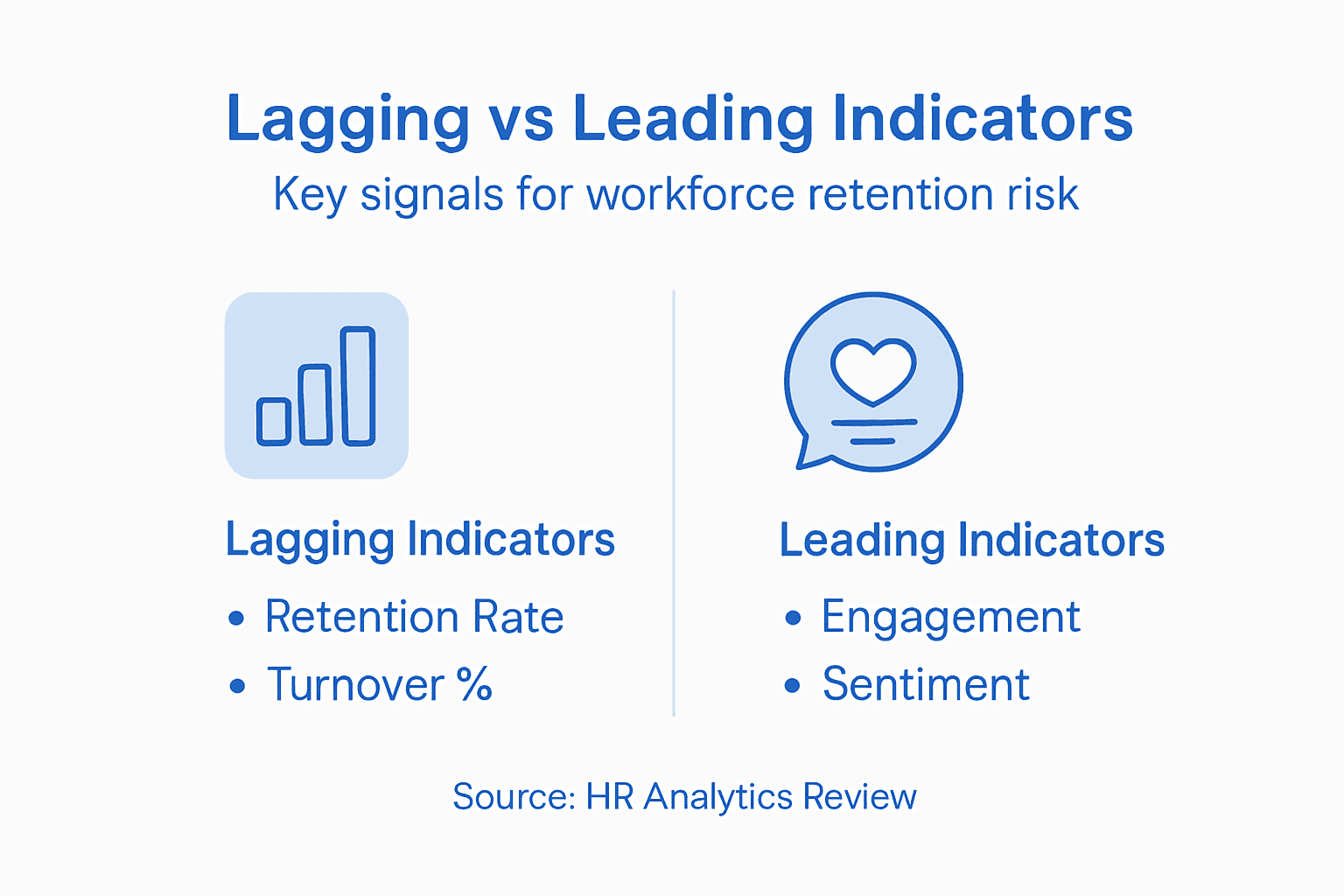
Lagging indicators include:
-
Retention rate
-
Turnover rate
-
Resignation count
-
Exit interview themes
-
Replacement cost
-
Time to fill open roles
Leading indicators include:
-
Engagement risk
-
Manager-employee fit
-
Values alignment
-
Team trust and communication
-
Participation patterns
-
Absenteeism or withdrawal
-
Career growth confidence
-
Early signs of disengagement
The problem is not using retention data. The problem is using retention data alone.
| Indicator Type | What It Shows | Example Metrics | Leadership Limitation |
|---|---|---|---|
| Lagging indicators | What already happened | Retention rate, turnover rate, resignations, exit interviews | Too late to prevent the loss |
| Leading indicators | What may be forming now | Engagement risk, values alignment, manager fit, team friction | Requires earlier attention and action |
How Turnover Metrics Miss Early Risk
Turnover metrics miss early risk because they only capture the final event.
A resignation does not show when the employee first started disengaging. It does not show when the manager relationship weakened. It does not show when team friction began affecting motivation. It does not show when the employee stopped seeing a future inside the company.
Turnover reports may tell leaders:
-
Who left
-
When they left
-
Which team they left from
-
Whether the departure was voluntary or involuntary
-
How many people left during a period
But they often miss:
-
Who is becoming disengaged now
-
Where manager-employee friction is forming
-
Which teams have hidden tension
-
Whether values alignment is weakening
-
Whether employees still feel connected to the company
-
Where avoidable turnover may be building
By the time turnover data appears, the company may already have paid for months of lost motivation, weaker productivity, and leadership distraction.

Warning Signals Leaders Often Overlook
Retention risk often shows up before resignation, but the signs are easy to dismiss.
Leaders may assume a quiet employee is just busy. They may assume lower energy is temporary stress. They may assume reduced participation is a personality trait. But when these patterns continue, they may indicate that someone is beginning to disconnect.
Warning signals leaders often overlook include:
-
Reduced communication
-
Lower participation in meetings
-
Less initiative
-
Fewer ideas or suggestions
-
Slower response times
-
Increased absenteeism or lateness
-
Less openness with a manager
-
More visible frustration
-
Lower collaboration with teammates
-
Reduced interest in growth opportunities
-
A shift from ownership to basic task completion
-
Emotional withdrawal from the team
One signal may not mean someone is leaving. A pattern of signals should get attention.
The better question is not, “Did this person resign?”
The better question is, “Is this person still engaged, aligned, and connected?”
Transforming Leadership With Predictive Insight
Predictive insight helps leaders move from reacting after turnover to identifying risk before resignation.
This does not mean treating people like data points. It means using better signals to guide better leadership conversations.
Predictive insight can help leaders see:
-
Where disengagement may be forming
-
Which manager-employee relationships may need support
-
Where values alignment may be weak
-
Which teams may have hidden friction
-
Whether employees feel connected to the company
-
Whether employees still see a future inside the organization
-
Where stay conversations should happen sooner
The goal is not to predict people mechanically. The goal is to give leaders earlier visibility into the conditions that increase turnover risk.
Retention improves when leaders can see the risk while there is still time to act.
Integrating Leading Indicators Into Decision-Making
Leading indicators help leaders make retention decisions before turnover becomes visible.
Instead of waiting for resignation data, leaders can track the conditions that often come before turnover: disengagement, weak manager fit, values misalignment, team friction, low trust, and declining growth confidence.
Useful leading indicators include:
| Leading Indicator | What It Helps Leaders See |
|---|---|
| Engagement risk | Whether employees may be emotionally disconnecting |
| Manager-employee fit | Whether relationship friction may be creating risk |
| Values alignment | Whether employees feel connected to how the company works |
| Team alignment | Whether collaboration and trust are weakening |
| Growth confidence | Whether employees see a future inside the company |
| Participation patterns | Whether employees are withdrawing from team contribution |
| Sentiment feedback | Whether morale or motivation is shifting |
Leading indicators are only useful if leaders act on them.
The strongest retention strategy is not more reporting. It is earlier visibility followed by targeted action.
| Approach | What It Shows | Business Value |
|---|---|---|
| Retention risk measurement | Where disengagement may be forming | Earlier intervention |
| Values alignment insight | Whether employees feel connected to the company environment | Better understanding of hidden misalignment |
| Manager-employee fit analysis | Where relationship friction may exist | More targeted support |
| Team alignment data | Where collaboration or trust may be weakening | Stronger team stability |
| Stay conversations | What employees may not say in normal meetings | Earlier retention action |
Stop Managing Retention Through the Rearview Mirror
Retention is a lagging indicator. By the time turnover appears in the data, disengagement, manager friction, values misalignment, or team tension may already have been building for months.
OpenElevator helps CEOs, founders, senior leaders, and managers see retention risk earlier.
Through a simple five-minute, bias-free survey, OpenElevator gives leaders clearer visibility into values alignment, engagement risk, manager-employee fit, and hidden team friction.
Instead of waiting for resignations or exit interviews, leaders can see where risk may already be forming and take targeted action sooner.
Want to stop being told about retention risk too late? Start with OpenElevator’s free team scan.

Frequently Asked Questions
Why is retention a lagging indicator?
Retention is a lagging indicator because it measures who stayed after a period of time has already passed. It shows the outcome, not the earlier signals that may have led employees to disengage or leave.
What is the difference between retention and turnover?
Retention measures how many employees stay. Turnover measures how many employees leave. Both are lagging indicators because they show what happened after employee decisions and workplace conditions have already played out.
What are leading indicators of retention risk?
Leading indicators of retention risk include disengagement, manager-employee friction, values misalignment, team tension, absenteeism, lower participation, reduced initiative, and declining confidence in growth opportunities.
Why do leaders miss early retention risk?
Leaders often miss early retention risk because employees may still appear professional and productive while quietly disengaging. The warning signs are often subtle until resignation becomes likely.
How can leaders stop reacting too late to turnover?
Leaders can stop reacting too late by tracking leading indicators such as engagement risk, manager-employee fit, values alignment, and team friction before employees leave.
How does OpenElevator help with leading retention indicators?
OpenElevator helps leaders identify leading indicators of retention risk, including values alignment, engagement risk, manager-employee fit, and hidden team friction, through a five-minute, bias-free survey.