
Nearly one in every five american companies faces significant disruption each year due to employee attrition. Understanding why workers leave, and how different types of exits affect organizations, is crucial for leaders who want to protect business stability. When you get clear on what attrition really means and what drives it, you gain the insights needed to keep valuable talent and strengthen your team for long-term success.
Table of Contents
- Defining Employee Attrition And Key Concepts
- Types Of Employee Attrition Explained
- Primary Causes Behind Employee Attrition
- Business Impact Of High Attrition Rates
- Effective Strategies To Manage Attrition
Key Takeaways
| Point | Details |
|---|---|
| Understanding Attrition Types | Recognizing the different types of employee attrition—voluntary, involuntary, functional, and dysfunctional—enables leaders to tailor retention strategies effectively. |
| Addressing Root Causes | Tackling fundamental issues such as inadequate compensation, work-life imbalance, and poor management can help mitigate employee departures. |
| Impact on Business Performance | High attrition rates can lead to financial drains, productivity declines, and loss of competitive edge, necessitating strategic responses. |
| Implementation of Retention Strategies | Developing comprehensive retention plans, including competitive compensation and clear career advancement opportunities, is essential for sustaining workforce stability. |
Defining Employee Attrition and Key Concepts
Employee attrition represents a critical organizational challenge that goes far beyond simple workforce turnover. According to SHRM, attrition is defined as the gradual reduction of a workforce through various exit pathways, including resignations, retirements, and employee deaths. Unlike straightforward turnover, attrition reflects a more nuanced process of workforce transformation that can significantly impact an organization’s strategic capabilities.
The landscape of employee attrition encompasses multiple dimensions and types. Coursera highlights several distinct categories of attrition that business leaders must understand:
- Voluntary Attrition: Employees choosing to leave the organization by personal decision
- Involuntary Attrition: Workforce reductions through layoffs or terminations
- Retirement Attrition: Planned departures of long-term employees reaching retirement age
- Internal Attrition: Employees moving between departments or roles within the same organization
- Demographic-Specific Attrition: Patterns of exit concentrated within particular employee groups
Understanding these variations helps leaders develop targeted retention strategies. Calculating your organization’s attrition rate requires tracking the number of employees who leave during a specific period, divided by the total workforce, and then multiplied by 100.
 This metric provides crucial insights into workforce stability and potential underlying issues driving employee departures. Proactive leaders recognize that attrition isn’t just a number—it represents real human capital, institutional knowledge, and potential organizational disruption.
Effective attrition management demands a holistic approach. Business leaders must look beyond surface-level metrics to understand the root causes driving employee exits. Factors like compensation structures, workplace culture, professional development opportunities, and management practices all play significant roles in an employee’s decision to stay or leave. By developing comprehensive retention strategies that address these multifaceted concerns, organizations can transform attrition from a passive challenge into an active opportunity for workforce optimization.
Types of Employee Attrition Explained
Employee attrition is a multifaceted phenomenon with nuanced categories that reflect the complex dynamics of workforce transitions. SHRM provides a comprehensive framework for understanding these variations, highlighting that not all employee departures are created equal. By recognizing the distinct types of attrition, business leaders can develop more targeted strategies to manage and mitigate workforce changes.
QIC-WD outlines several critical categories of employee attrition that demand careful consideration:
- Voluntary Attrition: Employees who choose to leave the organization on their own terms
- Involuntary Attrition: Workforce reductions initiated by the employer through layoffs or terminations
- Functional Attrition: Strategic departures that potentially benefit the organization by replacing underperforming employees
- Dysfunctional Attrition: Loss of high-performing or critical talent that negatively impacts organizational performance
- Internal Attrition: Movement of employees between departments or roles within the same company
Understanding the distinction between these types of attrition is crucial for developing nuanced workforce management strategies. Functional attrition, for instance, can be a strategic opportunity to refresh talent pools and introduce new skills, while dysfunctional attrition represents a significant risk to organizational knowledge and performance. Business leaders must develop sophisticated tracking and intervention mechanisms to distinguish between these different forms of workforce change.
The implications of each attrition type extend far beyond simple headcount metrics. Strategic attrition management requires a deep understanding of the underlying causes and potential consequences of employee departures. Factors such as workplace culture, compensation structures, career development opportunities, and management practices all play critical roles in determining whether an organization experiences functional or dysfunctional attrition. By adopting a proactive and holistic approach to workforce retention, leaders can transform attrition from a passive challenge into a strategic opportunity for organizational growth and optimization.
Primary Causes Behind Employee Attrition
Employee attrition is rarely a result of a single factor, but rather a complex interplay of organizational and personal dynamics. SHRM provides critical insights into the multifaceted nature of workforce departures, revealing that organizations must look beyond surface-level explanations to truly understand why talented professionals choose to leave.
Coursera highlights several primary drivers of employee attrition that demand strategic attention:
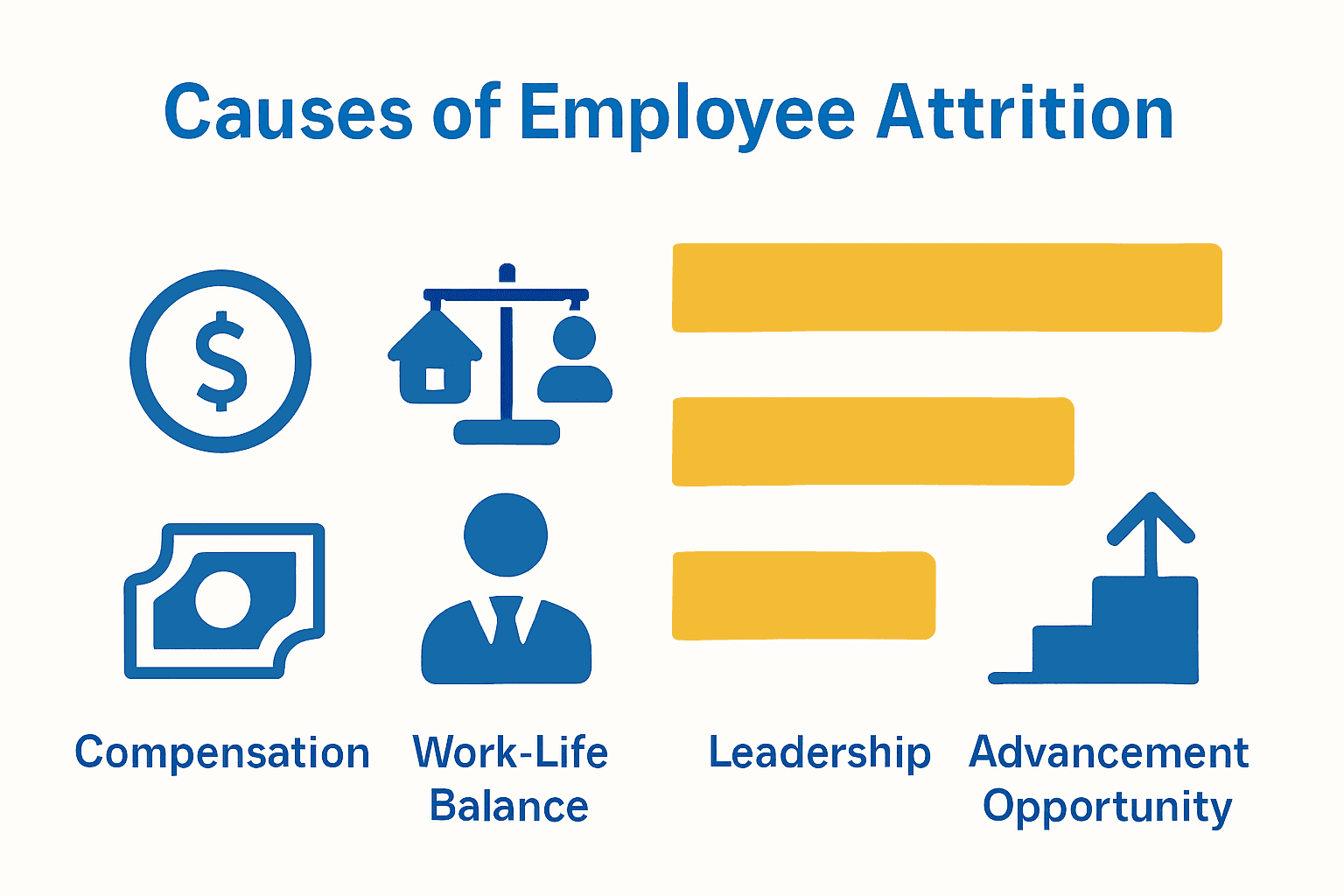
- Compensation Inadequacy: Salaries and benefits that fail to match market standards or employee expectations
- Work-Life Imbalance: Excessive workloads and expectations that compromise personal well-being
- Limited Career Progression: Absence of clear advancement pathways or professional development opportunities
- Management Dysfunction: Poor leadership practices, lack of support, and ineffective communication
- Cultural Misalignment: Workplace environments that do not resonate with employee values and aspirations
Understanding these root causes requires more than superficial analysis. Systemic workplace challenges often create cumulative frustrations that ultimately drive talented professionals toward exit. Compensation, while critical, represents just one dimension of employee retention. Modern workers seek holistic experiences that encompass meaningful work, personal growth, psychological safety, and organizational alignment.
Leaders must recognize that attrition is a symptom of deeper organizational health issues. Proactive retention strategies demand continuous feedback loops, transparent communication, and a genuine commitment to employee development. By addressing the underlying factors that contribute to workforce dissatisfaction, organizations can transform potential loss points into opportunities for engagement, innovation, and sustained talent retention.
Business Impact of High Attrition Rates
High employee attrition is far more than a human resources statistic—it represents a critical business performance challenge with profound financial and operational consequences. Journals reveal that organizations experiencing elevated attrition rates face significant disruptions across multiple strategic dimensions, challenging their ability to maintain competitive momentum and organizational stability.
RSIS International highlights several key business impacts of persistent workforce turnover:
- Financial Drain: Substantial recruitment, onboarding, and training expenses
- Productivity Decline: Continuous knowledge gaps and reduced team performance
- Operational Disruption: Increased workload for remaining employees
- Talent Quality Erosion: Potential loss of institutional knowledge and expertise
- Competitive Disadvantage: Reduced organizational agility and market responsiveness
Understanding the true cost of attrition requires a holistic view beyond simple replacement expenses. Indirect costs often represent the most significant financial burden, including decreased team morale, reduced institutional knowledge, and potential client relationship disruptions. The compounding effect of these factors can create a negative organizational spiral that becomes increasingly difficult to interrupt.
Strategic leaders must recognize that high attrition rates are symptomatic of deeper organizational health challenges. Transforming these potential vulnerabilities demands a proactive, multifaceted approach that addresses root causes, rebuilds employee engagement, and creates sustainable workforce retention strategies. By viewing attrition not as an inevitable expense but as an opportunity for systemic improvement, organizations can convert potential organizational weakness into a competitive advantage.
Effective Strategies to Manage Attrition
Addressing employee attrition requires a sophisticated, multidimensional approach that goes beyond traditional retention tactics. SHRM emphasizes that successful attrition management demands a holistic strategy targeting fundamental organizational dynamics that influence employee engagement and loyalty.
Coursera recommends several strategic interventions for mitigating workforce turnover:
- Compensation Optimization: Regularly benchmark salaries and develop competitive total rewards packages
- Career Development: Create transparent advancement pathways and professional growth opportunities
- Workplace Culture: Foster an inclusive environment that aligns with employee values and aspirations
- Feedback Mechanisms: Implement continuous listening strategies and responsive communication channels
- Leadership Development: Invest in management training to improve team engagement and support
Successful attrition management requires more than reactive measures. Strategic retention involves creating an ecosystem where employees feel valued, challenged, and intrinsically connected to the organization’s mission. This means moving beyond transactional employment relationships toward genuine partnerships that prioritize mutual growth and shared success.
Proactive leaders understand that managing attrition is an ongoing process of organizational learning and adaptation. By developing sophisticated talent management approaches that anticipate and address workforce needs, companies can transform potential turnover challenges into opportunities for continuous improvement, innovation, and sustainable competitive advantage.
Take Control of Employee Attrition and Protect Your Workforce
Employee attrition can disrupt productivity, drain resources, and threaten your company’s future. As the article highlights, challenges like voluntary attrition, management dysfunction, and cultural misalignment are more than just numbers. They affect your people, your knowledge base, and your competitive edge. If you want to move from reacting to attrition towards actively preventing it, targeted strategies are essential.
OpenElevator offers a proven solution designed to identify employees at high risk of quitting before it’s too late. Our proprietary algorithm helps you pinpoint specific turnover risks and implements personalized retention plans tailored to your workforce. Whether you are a startup or a Fortune 500 company, discover how you can transform attrition from a costly problem into an opportunity for sustainable growth. Take the first step today by visiting OpenElevator and learn why companies worldwide trust us to solve high turnover. Explore our platform and start securing your talent now.
Frequently Asked Questions
What is employee attrition?
Employee attrition refers to the gradual reduction of a workforce through voluntary and involuntary exits, such as resignations, retirements, and lay-offs. It goes beyond simple turnover, impacting organizational capabilities.
What are the main types of employee attrition?
The main types include voluntary attrition (employees leaving by choice), involuntary attrition (layoffs or terminations), retirement attrition (long-term employees retiring), internal attrition (employees moving within the company), and demographic-specific attrition (exit trends among particular employee groups).
What are the primary causes of employee attrition?
Common causes of employee attrition include inadequate compensation, work-life imbalance, limited career advancement opportunities, poor management practices, and cultural misalignment within the organization.
How does high attrition affect a business?
High attrition can lead to significant financial burdens due to recruitment and training costs, productivity declines, operational disruptions, erosion of talent quality, and overall competitive disadvantage for the organization.