
Job satisfaction affects retention long before an employee resigns.
When employees feel valued, aligned, supported, and connected to their work, they are more likely to stay. When satisfaction weakens, the risk often builds quietly through disengagement, manager friction, lack of growth, values misalignment, or reduced trust.
The problem for leaders is that dissatisfaction is not always obvious.
An employee may still attend meetings, complete tasks, and appear professional while becoming less motivated or less committed underneath the surface.
For CEOs, founders, and senior leaders, job satisfaction is not just an employee sentiment issue. It is an early visibility signal for retention risk.
This article explains how job satisfaction affects retention, what drives employee loyalty, how satisfaction connects to turnover, and how leaders can detect risk before employees leave.
Table of Contents
Key Takeaways
| Point | Details |
|---|---|
| Job satisfaction affects retention | Employees are more likely to stay when they feel valued, aligned, supported, and able to grow. |
| Dissatisfaction can be hidden | Employees may appear productive while disengagement or misalignment is already building. |
| Loyalty depends on more than pay | Manager fit, values alignment, growth, recognition, and team connection all affect retention. |
| Earlier visibility matters | Leaders need to detect satisfaction problems before they become turnover. |
Defining Job Satisfaction and Retention
Job satisfaction is the degree to which employees feel positive, supported, valued, and fulfilled in their work.
Retention is the company’s ability to keep employees over time.
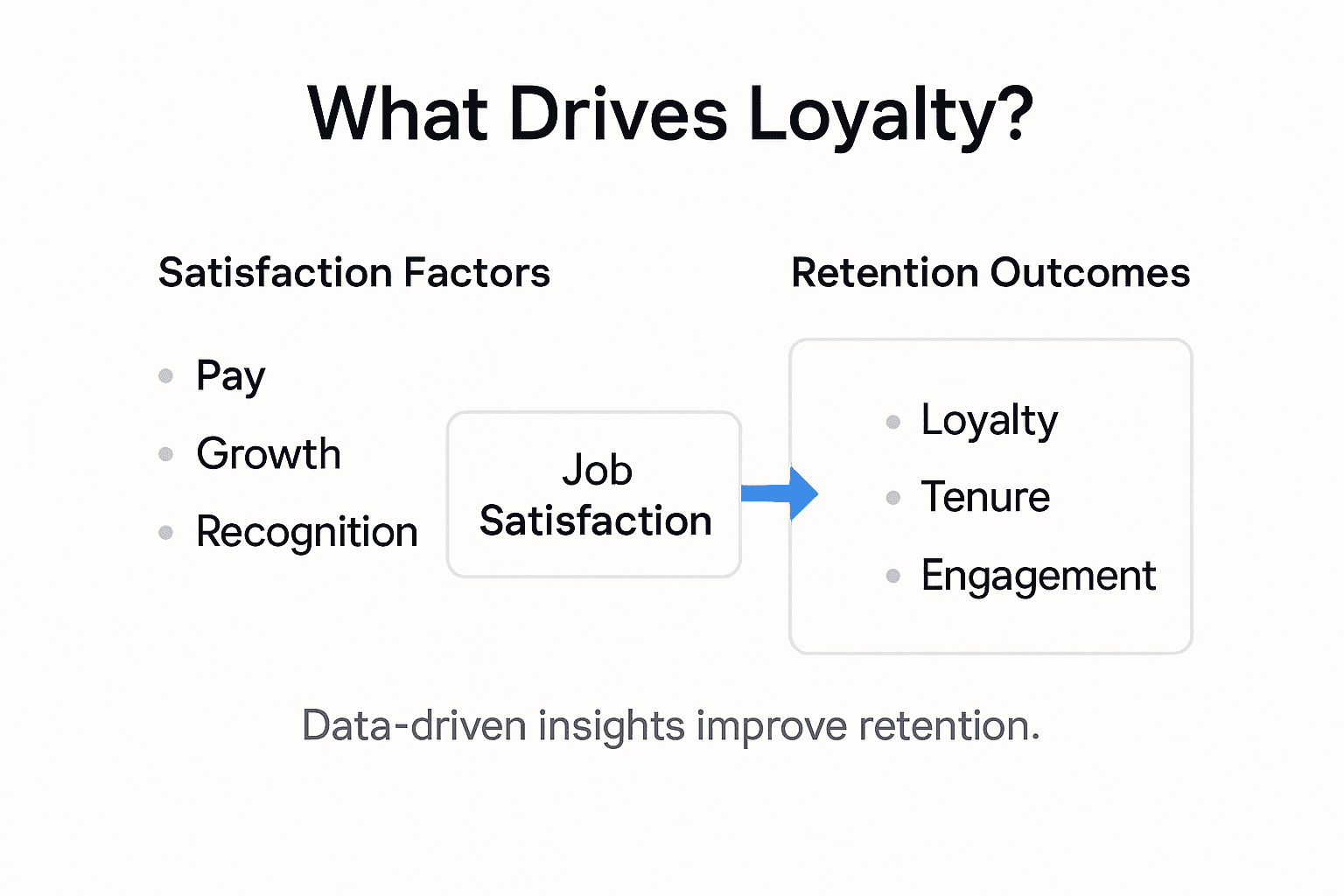
The two are closely connected. When job satisfaction is strong, employees are more likely to stay engaged and committed. When job satisfaction weakens, employees may begin to disengage, reduce effort, withdraw from the team, or consider leaving.
Job satisfaction includes several factors:
-
Manager-employee fit
-
Values alignment
-
Meaningful work
-
Recognition
-
Career growth
-
Fair compensation
-
Team trust and communication
-
Workload and burnout risk
-
Psychological safety
-
Sense of belonging
In simple terms: job satisfaction shows whether employees want to keep investing in the company. Retention shows whether they actually stay.
The leadership risk is assuming satisfaction is fine because turnover has not happened yet.
Major Drivers of Employee Satisfaction
Employee satisfaction is not driven by one factor.
Pay matters, but employees also need to feel seen, aligned, trusted, and able to grow. A person can be well paid and still leave if the manager relationship is weak, the work feels misaligned, or the team environment creates friction.
Major drivers of job satisfaction include:
| Satisfaction Driver | What It Means | Retention Impact |
|---|---|---|
| Manager-employee fit | The employee works well with their direct manager | Weak fit can create friction and disengagement |
| Values alignment | The employee feels connected to how the company works | Misalignment can lead to quiet withdrawal |
| Recognition | The employee feels seen for their contribution | Low recognition can reduce motivation |
| Career growth | The employee sees a future inside the company | Lack of growth can trigger job searching |
| Team connection | The employee feels part of a trusted team | Weak connection can increase isolation |
| Fair compensation | Pay feels appropriate for the role and market | Unfair pay can increase turnover risk |
| Workload balance | Work feels sustainable | Burnout can damage satisfaction and retention |
Leaders need to understand which driver is weakening. Generic satisfaction efforts do not solve specific retention risks.

How Satisfaction Impacts Turnover Rates
Low job satisfaction often appears before turnover.
Employees rarely move from satisfied to resigned overnight. The pattern usually builds over time: motivation drops, communication changes, initiative declines, and the employee becomes less connected to the manager, team, or company.
Low satisfaction can show up as:
-
Reduced participation
-
Less initiative
-
Lower collaboration
-
Shorter communication
-
More frustration
-
Less interest in growth
-
Emotional withdrawal
-
Increased absenteeism
-
A shift from ownership to basic task completion
The danger is that these signs can be easy to dismiss.
A leader may think an employee is simply busy, quiet, or stressed. But when the pattern continues, it may signal that satisfaction is weakening and retention risk is rising.
The better question is not, “Is this employee still here?”
The better question is, “Is this employee still engaged, aligned, and likely to stay?”
Measuring Job Satisfaction Effectively
Job satisfaction cannot be measured only through annual surveys.
Annual surveys may show broad sentiment, but they often miss changes that happen between measurement points. They may also miss the employees who are already disengaging but do not speak openly.
To measure job satisfaction effectively, leaders need signals that show where satisfaction may be weakening.
Useful satisfaction and retention signals include:
| Signal | What It Helps Leaders See |
|---|---|
| Engagement risk | Whether employees may be emotionally disconnecting |
| Manager-employee fit | Whether relationship friction may be affecting satisfaction |
| Values alignment | Whether employees feel connected to how the company works |
| Growth confidence | Whether employees see a future inside the company |
| Recognition | Whether employees feel seen and valued |
| Team alignment | Whether collaboration and trust may be weakening |
| Workload pressure | Whether burnout may be affecting motivation |
| Participation patterns | Whether employees are withdrawing from contribution |
The goal is not more measurement for its own sake. The goal is earlier visibility into the conditions that affect whether employees stay or leave.
| Measurement Method | What It Captures | Limitation |
|---|---|---|
| Annual survey | Broad employee sentiment | May miss fast-moving risk |
| Pulse survey | More frequent feedback | Still depends on honest responses |
| Manager check-ins | Direct context and conversation | Employees may not share everything |
| Performance metrics | Output and delivery | Does not show motivation or alignment |
| Alignment data | Values, manager fit, team fit, and risk signals | Requires leaders to act on the insight |
Strategies to Improve Retention Through Satisfaction
Improving retention through job satisfaction starts with understanding what is actually causing dissatisfaction.
If the issue is manager friction, a compensation adjustment may not solve it. If the issue is lack of growth, more recognition may not be enough. If the issue is values misalignment, flexible work alone will not fix the problem.
Effective strategies include:
-
Strengthen manager-employee relationships
-
Identify values alignment and misalignment
-
Clarify career growth paths
-
Recognize specific contributions
-
Address team friction early
-
Monitor workload and burnout risk
-
Create psychologically safe feedback channels
-
Hold stay conversations before employees disengage
-
Use data to identify where satisfaction is weakening
-
Take targeted action based on the actual risk signal
Retention improves when leaders stop treating job satisfaction as a vague morale issue and start treating it as an early signal of turnover risk.
See Satisfaction Problems Before They Become Turnover
Job satisfaction affects retention, but dissatisfaction is not always visible.
Employees may still be performing while engagement, manager fit, values alignment, or team connection is already weakening underneath the surface.
OpenElevator helps CEOs, founders, senior leaders, and managers detect retention risk earlier.
Through a simple five-minute, bias-free survey, OpenElevator gives leaders clearer visibility into values alignment, engagement risk, manager-employee fit, and hidden team friction.
Instead of guessing whether employees are satisfied, leaders can see where risk may already be forming and act sooner.
Want to see where job satisfaction may be weakening inside your team? Start with OpenElevator’s free team scan.

Frequently Asked Questions
How does job satisfaction affect retention?
Job satisfaction affects retention because employees are more likely to stay when they feel valued, aligned, supported, recognized, and able to grow inside the company.
What are the main drivers of job satisfaction?
The main drivers of job satisfaction include manager-employee fit, values alignment, meaningful work, recognition, career growth, fair compensation, team trust, and workload balance.
What are signs that job satisfaction is weakening?
Signs include reduced participation, lower initiative, shorter communication, more frustration, less collaboration, absenteeism, emotional withdrawal, and declining interest in growth.
Why is job satisfaction hard for leaders to see?
Job satisfaction is hard to see because employees may still perform well while quietly disengaging. Leaders may not notice the risk until satisfaction has already turned into turnover intent.
How can leaders improve retention through job satisfaction?
Leaders can improve retention by identifying the specific reason satisfaction is weakening, such as manager friction, values misalignment, lack of growth, low recognition, or team tension.
How does OpenElevator help with job satisfaction and retention?
OpenElevator helps leaders identify retention risk, values alignment, engagement risk, manager-employee fit, and hidden team friction through a five-minute, bias-free survey.