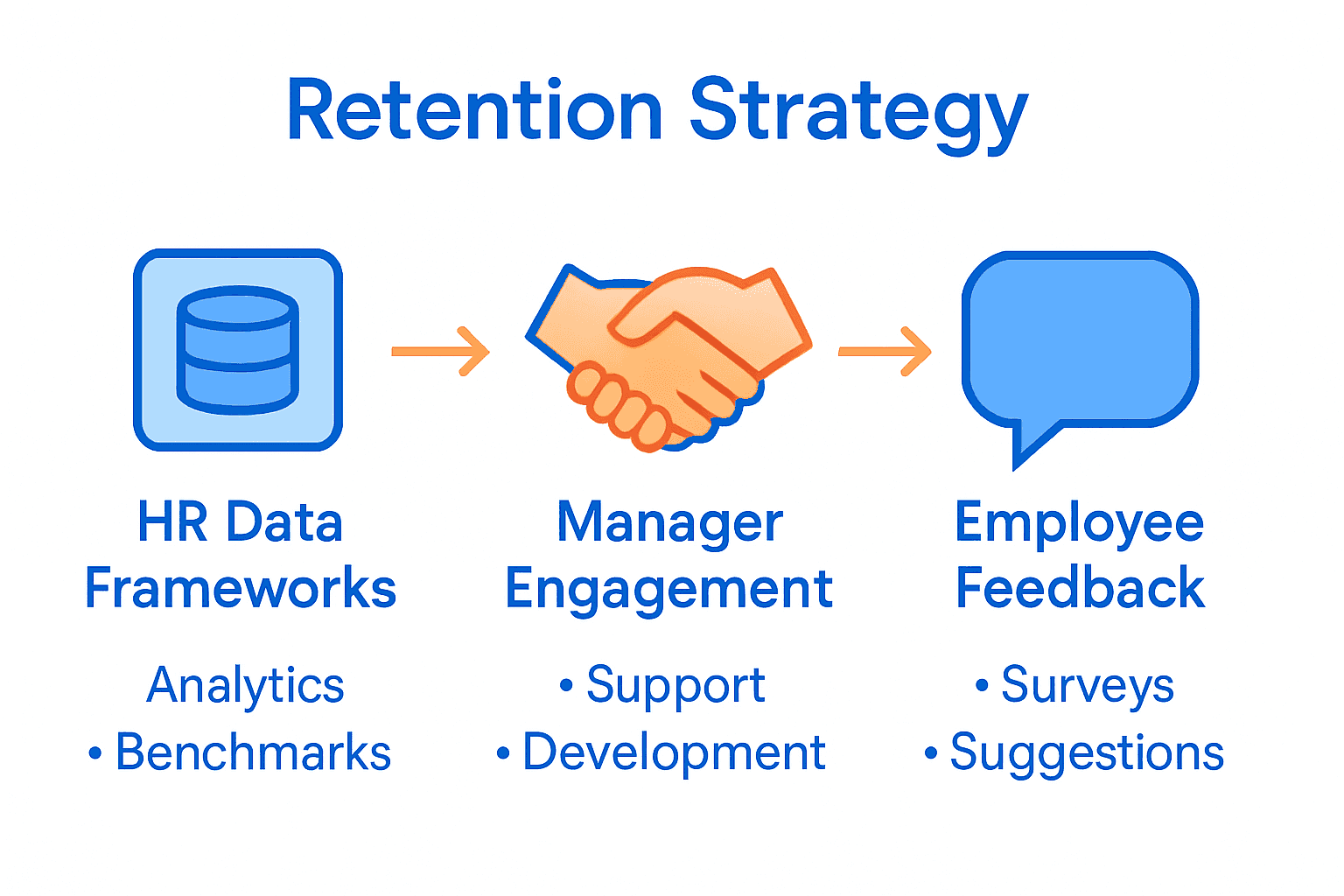
Nearly 60 percent of employees say they would leave a job if they felt undervalued or disconnected from their team. In today’s competitive market, the real challenge for organizations isn’t just finding great talent but keeping it. Understanding HR’s evolving role in employee retention helps leaders build workplaces where professionals truly want to stay. This article highlights the latest HR strategies that drive real employee engagement and long-term loyalty.
Table of Contents
- Defining HR’s Role in Retention Today
- Common Misconceptions About HR and Retention
- Manager Versus HR: Who Truly Influences Retention
- Key Drivers of Employee Engagement and Loyalty
- Strategic Solutions for Lasting Employee Retention
Key Takeaways
| Point | Details |
| HR’s Evolving Role | HR is transitioning from an administrative function to a strategic partner focused on enhancing employee experience and retention. |
| Cultural Dynamics Matter | Retention strategies must recognize the importance of workplace culture, manager interactions, and personalized employee engagement. |
| Data-Driven Insights | Utilizing advanced analytics is essential for predicting turnover and tailoring retention strategies to individual needs. |
| Collaborative Approach | Retention is a shared responsibility among HR, managers, and employees, necessitating aligned strategies and clear communication. |
Defining HR’s Role in Retention Today
Traditionally, organizations have misunderstood employee retention as a purely HR-driven responsibility. But here’s the reality: retention isn’t about polished policies or sporadic engagement surveys. It’s about creating an ecosystem where talented professionals feel genuinely valued, challenged, and connected to their work.
HR’s contemporary role in retention is less about being a gatekeeper and more about being a strategic architect of employee experience. Think of HR professionals as internal consultants who design systemic approaches to understanding, supporting, and proactively addressing workforce dynamics. Their primary responsibilities now encompass:
- Developing sophisticated talent mapping strategies
- Creating data-driven retention frameworks
- Implementing predictive analytics for potential turnover
- Designing meaningful professional development pathways
- Facilitating communication channels between management and employees
The fundamental shift is recognizing that HR cannot single-handedly solve retention challenges. Their role is to provide tools, insights, and strategic recommendations that empower direct managers and leadership to create compelling workplace environments. They’re the navigators, not the sole drivers, of an organization’s retention strategy.
Modern HR professionals must function like organizational anthropologists – continuously studying workplace culture, identifying subtle engagement signals, and translating complex human dynamics into actionable insights. By leveraging advanced technological platforms and sophisticated analytical tools, they can now predict potential flight risks with remarkable precision and recommend targeted intervention strategies before top talent considers leaving.

Common Misconceptions About HR and Retention
The world of human resources is plagued by persistent myths that dramatically undermine organizational understanding of retention strategies. Perhaps the most damaging misconception is that HR is a purely administrative function, responsible for paperwork and compliance rather than strategic talent management.
One significant fallacy is the belief that HR operates in isolation from business performance. OJS Research challenges this notion, demonstrating that strategic HR practices – particularly in sectors like automotive manufacturing – directly correlate with employee retention and organizational success. Specifically, the research highlights how targeted practices like career development and rewards systems can significantly influence an employee’s decision to stay or leave.
Key misconceptions about HR and retention include:
- HR is just about hiring and firing
- Employee engagement is solely an HR responsibility
- Retention strategies are one-size-fits-all
- Data analytics aren’t crucial in HR decision-making
- Compensation is the primary retention driver
Piscomed Review further dismantles these myths by emphasizing the transformative power of HR analytics. Modern HR isn’t about managing paperwork – it’s about leveraging sophisticated data insights to predict, understand, and proactively address workforce dynamics. By using advanced analytical tools, HR can now identify potential flight risks, understand complex engagement patterns, and develop targeted retention strategies that speak directly to individual employee needs.
The most dangerous misconception? That HR can solve retention challenges alone. In reality, retention is a holistic organizational strategy requiring collaboration between HR, direct managers, leadership, and employees themselves. HR’s role is to provide the framework, insights, and tools – but genuine employee satisfaction and commitment require a comprehensive, company-wide approach that values transparent communication, meaningful work, and continuous professional growth.
Manager Versus HR: Who Truly Influences Retention
The battle for employee retention isn’t a competition between HR and managers – it’s a strategic partnership where each plays a critical and distinct role. While HR designs the overarching framework, direct managers are the front-line architects of day-to-day employee experience and engagement.
Ignited Research reveals a nuanced perspective on organizational performance, demonstrating that effective retention isn’t about who has more influence, but how HR and managers collaborate to create a supportive work environment. Direct managers hold unprecedented power in retention because they have immediate, daily interactions that shape an employee’s perception of their workplace.
Key differences in retention influence include:
- Managers control daily work experience
- HR develops systemic retention strategies
- Managers provide immediate feedback and recognition
- HR creates long-term professional development pathways
- Managers understand individual team dynamics
- HR provides organizational-level insights
SO05 Research further validates this collaborative model by exploring retention mechanisms among university faculty. The study emphasizes that job satisfaction emerges from the intricate interplay between HR practices and managerial interactions, not from a unilateral approach.
Ultimately, retention is a shared responsibility. Managers are the primary retention agents through daily leadership, while HR provides the strategic infrastructure that supports and amplifies those efforts. The most successful organizations recognize this symbiotic relationship, creating aligned strategies that empower managers with the right tools, training, and organizational support to build genuinely engaging work environments.
Key Drivers of Employee Engagement and Loyalty
Employee engagement isn’t a mysterious alchemy – it’s a strategic ecosystem of interconnected human experiences that transform workplace relationships from transactional interactions to meaningful partnerships. Modern organizations understand that loyalty emerges from a holistic approach that addresses both professional and personal needs.
ArXiv Research provides critical insights into one of the most fundamental drivers of engagement: work-life balance. The study reveals that organizations which prioritize flexible working arrangements, mental health support, and genuine concern for employee well-being create significantly stronger loyalty bonds. This goes beyond traditional perks – it’s about creating an environment that respects individual life contexts and personal growth trajectories.
Key drivers of employee engagement include:
- Meaningful and challenging work assignments
- Transparent communication channels
- Opportunities for professional development
- Recognition of individual contributions
- Competitive and fair compensation structures
- Supportive and inclusive workplace culture
- Clear pathways for career progression
Job Embeddedness research offers another fascinating perspective, introducing the concept that employee loyalty is not just about workplace satisfaction, but about how deeply an employee is ‘embedded’ in their organizational and community ecosystem. This framework suggests that retention isn’t solely about what happens inside office walls, but how an employee’s professional identity integrates with their broader life narrative.
Ultimately, driving engagement requires a nuanced, personalized approach. Organizations must move beyond generic retention strategies and develop sophisticated, empathetic frameworks that recognize each employee as a unique individual with distinct motivations, aspirations, and personal circumstances. The most successful companies don’t just manage employees – they cultivate environments where professionals can authentically thrive, grow, and feel genuinely valued.
Strategic Solutions for Lasting Employee Retention
Employee retention isn’t a one-time initiative – it’s a continuous strategic commitment that requires sophisticated, multifaceted approaches tailored to modern workforce dynamics. Successful organizations recognize that retention strategies must evolve beyond traditional compensation models to create holistic, engaging work environments.
IRJMSS Research provides critical insights into sustainable organizational performance, emphasizing that effective retention goes far beyond surface-level interventions. The study underscores that strategic employee retention is fundamentally about creating an ecosystem where talented professionals feel genuinely valued, challenged, and connected to the organization’s broader mission.
Key strategic solutions for lasting retention include:
- Implementing personalized career development roadmaps
- Creating transparent performance feedback mechanisms
- Developing adaptive learning and upskilling programs
- Designing flexible work arrangements
- Building strong mentorship and coaching cultures
- Establishing meaningful recognition and reward systems
- Cultivating psychological safety within teams
HRMARS Research highlights the critical role of organizational trust as a fundamental retention catalyst. This research reveals that trust isn’t just a soft metric – it’s a tangible, measurable factor that directly influences an employee’s commitment, engagement, and long-term organizational loyalty.
Effective retention requires a proactive, data-driven approach that treats employees as valuable, complex individuals rather than replaceable resources. The most successful organizations will be those that create dynamic, responsive environments where professional growth, personal well-being, and organizational objectives seamlessly intersect. It’s about building a culture of mutual respect, continuous learning, and shared purpose that makes employees want to invest their best selves in the organization’s success.
Transform Your Retention Strategy with Data-Driven Insights
The article highlights how HR’s modern role includes leveraging predictive analytics and crafting targeted retention frameworks to address employee turnover before it happens. If you are struggling to identify who among your talent is at risk of leaving or feel overwhelmed by broad retention strategies that lack personalization, it is time to act with precision. Companies need tools that not only predict flight risks but also offer actionable solutions tailored to individual needs.
OpenElevator meets this challenge head-on by using a proprietary algorithm designed to uncover high-risk employees early so you can apply focused retention tactics that work. Whether you are an HR professional looking to enhance your data-driven approach or a manager wanting to improve day-to-day engagement, exploring OpenElevator’s proven retention strategies will empower your entire team. Start turning employee turnover from a costly problem into a strategic opportunity today by visiting OpenElevator. Don’t wait until valuable talent walks away—discover solutions that keep your people motivated and committed now.
Frequently Asked Questions
What is the role of HR in employee retention?
HR plays a strategic role in employee retention by acting as an architect of the employee experience, designing systematic approaches that support workforce dynamics and empowering managers to create engaging work environments.
How can HR use data to improve retention strategies?
HR can implement data-driven frameworks and predictive analytics to identify potential turnover risks, understand engagement patterns, and develop targeted retention strategies that address individual employee needs.
What misconceptions do people have about HR’s impact on retention?
Common misconceptions include the belief that HR is solely an administrative function, that retention strategies are one-size-fits-all, and that HR can solve retention challenges without collaboration from direct managers and leadership.
What are some key drivers of employee engagement and loyalty?
Key drivers include meaningful work assignments, transparent communication, opportunities for professional development, recognition of contributions, competitive compensation, and a supportive workplace culture.