
High turnover can feel like a constant barrier to building strong teams, especially in fast-paced American tech companies. Leaders increasingly need smarter tools to understand what drives their workforce and how to keep key talent from leaving. By using data-driven retention technologies such as predictive analytics and real-time engagement platforms, executives gain practical insights to spot early risks, personalize interventions, and foster a healthier employee experience—turning workforce data into actionable retention strategies.
Table of Contents
- Defining Technology’s Role in Retention Today
- Key Modern Retention Technologies Explained
- How Predictive Analytics Transforms Retention
- Real-World Applications and Current Case Studies
- Risks, Pitfalls, and Critical Success Factors
Key Takeaways
| Point | Details |
|---|---|
| Technology as a Strategic Partner | Modern organizations use technology not just as a tool but as a key ally in enhancing employee retention through data-driven insights. |
| Proactive Retention Strategies | Predictive analytics helps identify early signs of disengagement, enabling targeted interventions before employees consider leaving. |
| Holistic Employee Profiles | Integrated retention technologies create comprehensive profiles that reveal complex engagement patterns and motivations, leading to customized retention strategies. |
| Balance Between Technology and Human Insight | Successful retention strategies must combine technological capabilities with human judgment to maintain individual connection and foster genuine employee development. |
Defining Technology’s Role in Retention Today
In the rapidly evolving landscape of workforce management, technology has transformed from a passive tool to an active strategic partner in employee retention. Modern organizations now recognize that data-driven technological solutions provide unprecedented insights into team dynamics, engagement patterns, and potential turnover risks.
Technology’s role in retention today encompasses several critical dimensions:
- Predictive Analytics: Leveraging machine learning algorithms to forecast potential employee disengagement
- Real-Time Monitoring: Tracking subtle shifts in team communication and collaboration patterns
- Sentiment Analysis: Interpreting employee feedback and emotional signals within workplace interactions
- Performance Visualization: Creating transparent dashboards that reveal underlying team health metrics
These technological capabilities enable leaders to move beyond reactive strategies and implement proactive retention interventions. By identifying early warning signals before employees disengage, organizations can design targeted retention strategies that address root causes.
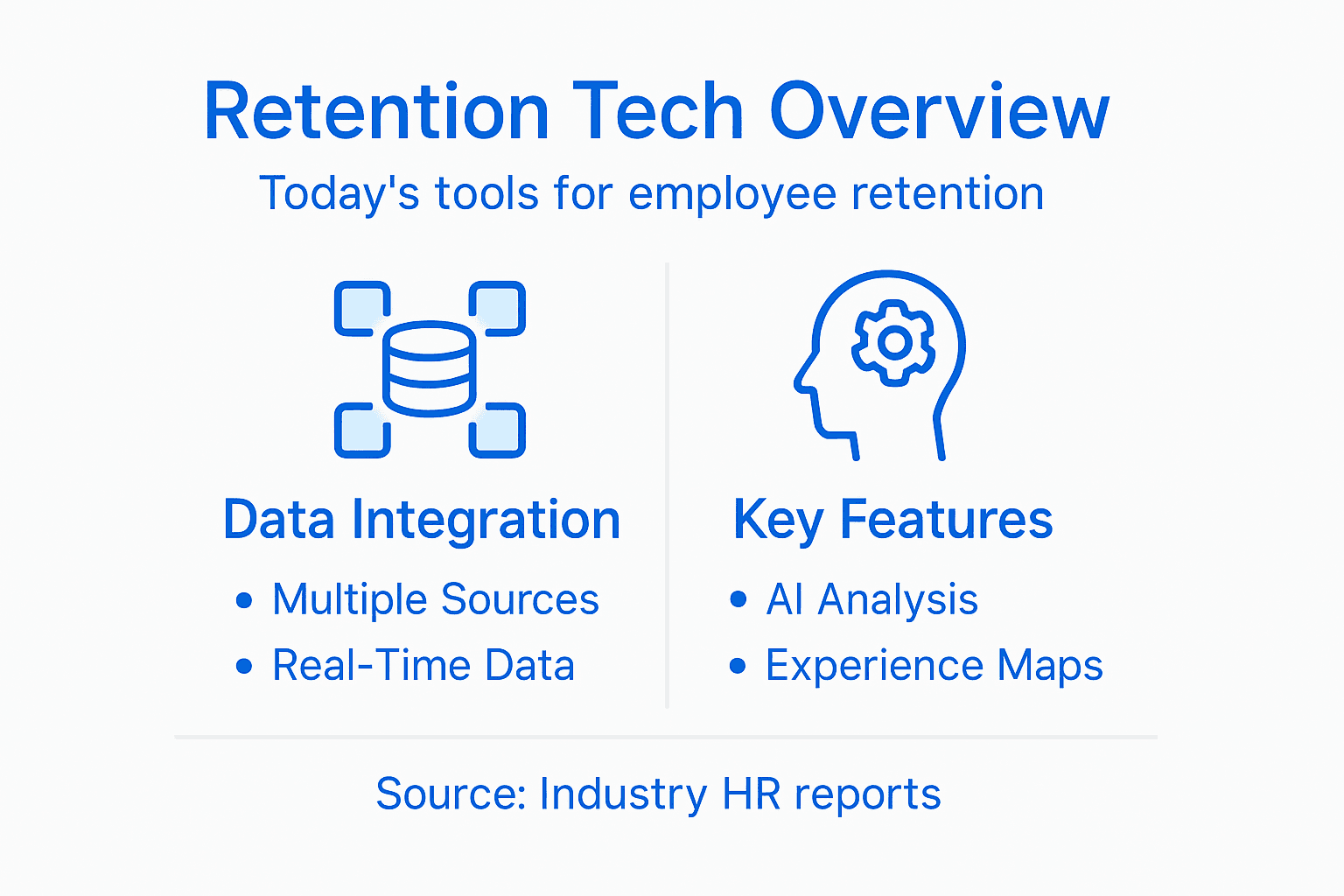
Most retention technologies now integrate multiple data sources to create comprehensive employee experience profiles. retention insights platform can aggregate communication patterns, performance metrics, engagement survey results, and individual team interactions to generate holistic workforce intelligence.
Employee Experience Mapping represents a quantum leap in understanding retention dynamics. Advanced technologies now track complex emotional and professional trajectories, allowing leadership to understand not just why employees leave, but how to create environments where they want to stay.
Pro tip: Implement technology solutions that provide granular, contextual insights rather than generic metrics.
Key Modern Retention Technologies Explained
Modern organizations are increasingly turning to sophisticated technological solutions to address the complex challenge of employee retention. Workforce analytics platforms have emerged as critical tools that transform raw employee data into actionable strategic insights.
The key modern retention technologies can be categorized into several breakthrough categories:
- AI-Powered Recruiting Tools: Identifying candidate compatibility beyond traditional metrics
- Skills-Based Hiring Platforms: Matching talent to organizational needs with precision
- Sentiment Analysis Systems: Detecting early signs of potential employee disengagement
- Continuous Learning Technologies: Providing personalized professional development pathways
- Performance Tracking Dashboards: Creating transparent, real-time employee progress visualization
Talent Management Technologies represent a quantum leap in understanding workforce dynamics. These integrated systems go beyond simple data collection, offering nuanced insights into employee experience, potential growth trajectories, and organizational engagement levels.

Here’s a comparison of key retention technologies and their strategic benefits:
| Technology Type | Key Benefit | Typical Use Case | Business Impact |
|---|---|---|---|
| AI Recruiting Tools | Improves candidate fit | Talent acquisition | Reduces turnover rate |
| Skills-Based Hiring | Matches skills precisely | Internal mobility | Increases productivity |
| Sentiment Analysis | Detects early disengagement | Employee feedback | Boosts engagement levels |
| Continuous Learning | Personalized skill development | Career advancement | Strengthens retention |
| Performance Dashboards | Real-time progress tracking | Goal setting | Enhances transparency |
Modern retention technologies are not just tracking tools – they’re strategic intelligence platforms that predict and prevent talent loss before it happens.
AI-driven talent management systems now enable organizations to create highly personalized employee experiences. By analyzing communication patterns, performance metrics, and individual learning preferences, these technologies help companies design targeted retention strategies that address unique workforce needs.
The most advanced retention technologies now integrate multiple data streams, creating comprehensive employee profiles that reveal complex engagement patterns. This holistic approach allows leadership to understand not just surface-level metrics, but the deeper emotional and professional motivations driving employee satisfaction.
Pro tip: Invest in technologies that offer contextual, predictive insights rather than simplistic numerical metrics.
How Predictive Analytics Transforms Retention
Predictive analytics has emerged as a game-changing approach in modern talent management, shifting organizations from reactive to proactive retention strategies. Employee retention research demonstrates how advanced analytical tools can decode complex workforce dynamics with unprecedented precision.
The core capabilities of predictive analytics in retention include:
- Early Warning Detection: Identifying potential flight risks before employees consider leaving
- Behavioral Pattern Analysis: Mapping engagement trajectories across individual and team levels
- Personalized Intervention Design: Creating targeted retention strategies based on unique employee profiles
- Risk Quantification: Translating subtle behavioral signals into measurable retention probabilities
- Continuous Feedback Integration: Dynamically updating predictive models with real-time workforce data
Predictive analytics transforms employee retention from an art of guesswork into a precise science of strategic intervention.
Workforce engagement analytics enable organizations to develop nuanced understanding of employee motivations. By analyzing communication patterns, performance metrics, and individual preferences, companies can now design hyper-personalized retention approaches that address underlying emotional and professional needs.
The most sophisticated predictive models go beyond simple correlation, utilizing machine learning algorithms to understand complex interdependencies within workforce ecosystems. These advanced systems can predict potential turnover with remarkable accuracy, allowing leadership to implement preemptive engagement strategies before talented employees consider alternative opportunities.
Pro tip: Invest in predictive analytics platforms that offer contextual insights, not just numerical predictions.
Real-World Applications and Current Case Studies
Technology-driven retention strategies are transforming how organizations approach workforce management, moving beyond theoretical concepts to tangible, measurable outcomes. Post-pandemic retention research reveals concrete examples of how innovative technological approaches are solving complex employee engagement challenges.
Several compelling case studies demonstrate the practical impact of retention technologies:
- Remote Work Optimization: Implementing flexible communication platforms
- Personalized Learning Pathways: Creating individual skill development programs
- Real-Time Engagement Monitoring: Tracking employee sentiment and intervention triggers
- Predictive Talent Mapping: Identifying potential leadership candidates internally
- Well-being Technology Integration: Designing holistic support ecosystems
Technology doesn’t just track retention – it actively creates environments where employees want to stay and grow.
Tech talent retention strategies showcase how organizations are using advanced platforms to address critical workforce challenges. By integrating AI-enabled sourcing, continuous learning technologies, and data-driven talent planning, companies are developing more responsive and adaptive retention approaches.
The most successful case studies reveal a common theme: technological solutions that prioritize individual employee experience. These approaches go beyond generic interventions, using sophisticated analytics to create personalized engagement strategies that recognize each employee’s unique professional journey and potential.
Pro tip: Implement retention technologies that offer nuanced, individual-focused insights rather than one-size-fits-all solutions.
Risks, Pitfalls, and Critical Success Factors
Navigating the complex landscape of technological retention strategies requires a nuanced understanding of potential risks and critical implementation factors. Retention technology research reveals that technology alone cannot solve workforce challenges without strategic human insight.
Key risks and potential pitfalls organizations must carefully consider include:
- Data Privacy Concerns: Ensuring employee information remains confidential and ethically managed
- Algorithmic Bias: Preventing technological systems from perpetuating discriminatory practices
- Over-Reliance on Metrics: Avoiding the trap of valuing numerical data over human experience
- Technology Implementation Fatigue: Managing organizational change and employee adaptation
- False Correlation Risks: Understanding the limitations of predictive analytics
Technology is a tool, not a solution – human judgment remains the critical differentiator in talent management.
Talent management strategies emphasize that successful technological integration requires more than just sophisticated platforms. Critical success factors demand a holistic approach that combines technological capabilities with inclusive leadership, continuous learning, and genuine commitment to employee development.
The most effective organizations recognize that technological retention tools must augment, not replace, human connection. This means creating systems that provide insights while preserving individual agency, maintaining transparent communication, and developing a culture of mutual respect and professional growth.
This summary highlights major risks and critical success factors for retention tech adoption:
| Challenge | Risk Example | Success Factor | Mitigation Strategy |
|---|---|---|---|
| Data Privacy | Confidentiality breaches | Secure data management | Strong access controls |
| Algorithmic Bias | Unintended discrimination | Regular bias monitoring | Diverse data sets |
| Over-Reliance | Ignoring human insight | Balanced decision-making | Human-led evaluation |
| Implementation Fatigue | Change resistance | Employee support | Incremental rollout |
Pro tip: Always prioritize human context and emotional intelligence when implementing technological retention solutions.
Unlock the Power of Data-Driven Retention Insight with OpenElevator
The article highlights a critical challenge every leader faces retention is often a lagging indicator. By the time employees choose to leave disengagement has already been quietly growing. This lack of clear visibility into the subtle signals below the surface makes proactive retention nearly impossible. Pain points like late warning signals and limited understanding of team dynamics often leave organizations reacting too late to prevent turnover.
OpenElevator addresses these exact challenges by transforming employee experience into quantifiable, actionable intelligence. Our platform provides early warning signals and predictive insights that reveal hidden retention risks and team health metrics long before disengagement turns into resignations. Using terms from the article such as “predictive analytics” and “employee experience” we give leaders the clarity needed to intervene strategically and retain top talent.
Replace guesswork with confidence by exploring how OpenElevator’s retention insights platform turns complex workforce data into clear leadership advantage.
Take control over retention today by visiting OpenElevator and see how our detailed analytics and clear recommendations help you act early and focus on what matters most. Don’t wait until your best employees walk away. Harness the technology of tomorrow to build a resilient, engaged workforce now.
Frequently Asked Questions
What is the role of predictive analytics in employee retention?
Predictive analytics plays a critical role in employee retention by identifying potential flight risks before employees consider leaving. It analyzes behavioral patterns and provides insights that enable organizations to implement personalized retention strategies.
How can sentiment analysis contribute to retaining employees?
Sentiment analysis helps organizations detect early signs of employee disengagement by interpreting feedback and emotional signals in workplace interactions, thus allowing preemptive measures to enhance engagement.
What are some key technologies used for employee retention today?
Key technologies include AI-powered recruiting tools, skills-based hiring platforms, sentiment analysis systems, continuous learning technologies, and performance tracking dashboards, all of which provide valuable data insights to improve retention efforts.
How does real-time monitoring impact employee retention strategies?
Real-time monitoring tracks subtle shifts in communication and collaboration patterns, providing immediate insights into team dynamics. This enables leaders to address potential issues proactively, enhancing overall employee experience and retention.