Employee retention matters because turnover rarely starts on resignation day.
By the time a strong employee gives notice, the risk has usually been building quietly through disengagement, manager friction, team misalignment, or lack of growth. Most leaders sense when something is off, but they often lack clear visibility into who is at risk or why.
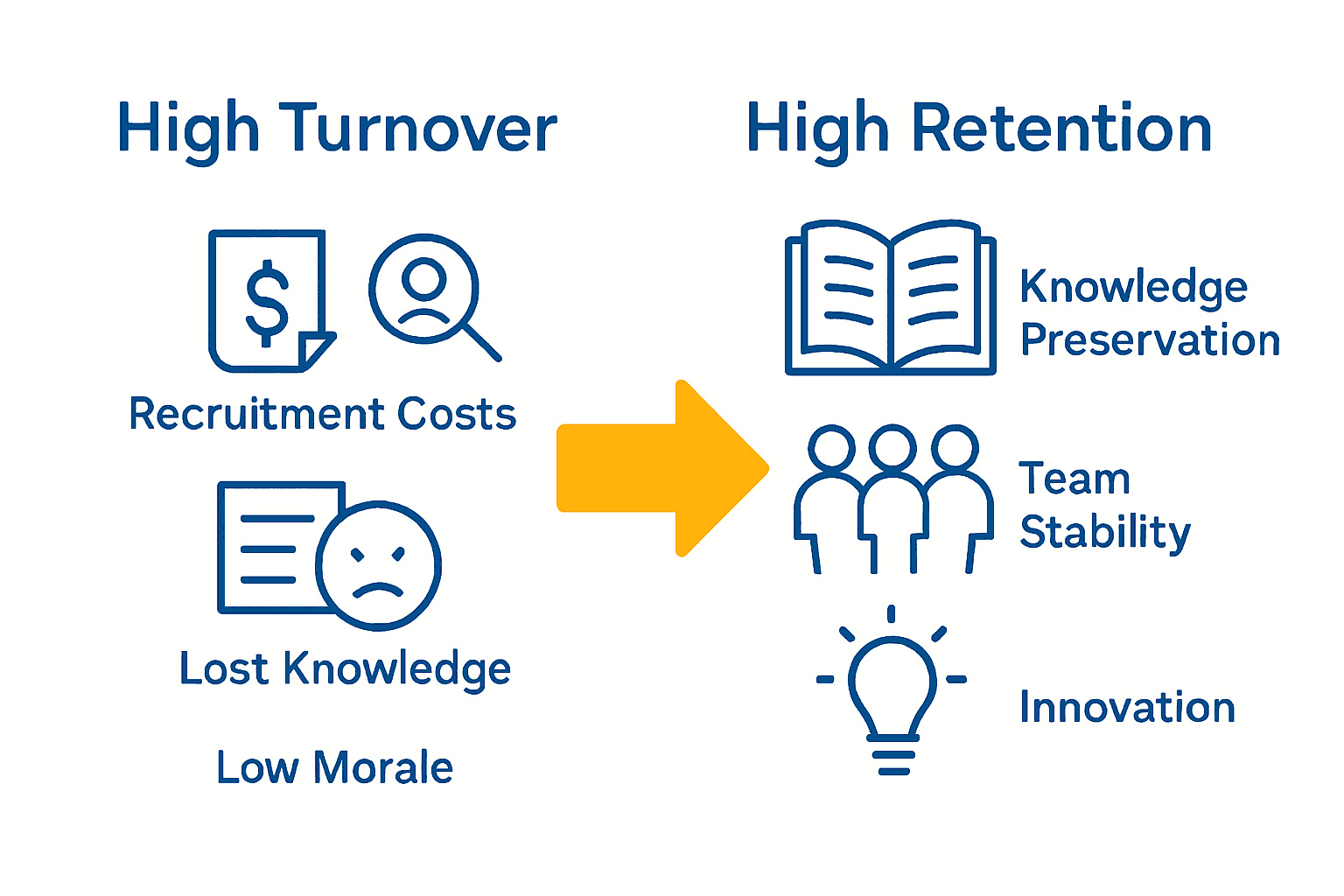
That visibility gap is expensive. When skilled employees leave, companies lose knowledge, momentum, customer context, productivity, and team stability. Replacement costs can be significant, but the deeper damage is often the disruption leaders did not see coming.
This guide explains why employee retention matters, what turnover really costs, why good employees leave before leaders realize it, and how leaders can detect retention risk earlier.
Table of Contents
-
What Employee Retention Really Means
-
The Hidden Costs of High Employee Turnover
-
Why Good Employees Leave Before Leaders Realize It
-
What Makes Employees Stay
-
Employee Retention Strategies That Create ROI
-
How Retention Impacts the Whole Organization
-
How OpenElevator Helps Leaders See Retention Risk Earlier
-
Key Takeaways
-
Frequently Asked Questions
Key Takeaways
| Point | Why It Matters |
|---|---|
| Retention is a leadership issue | Turnover affects growth, customer relationships, productivity, and team stability. |
| Turnover is expensive | Replacing employees can cost far more than recruiting fees when lost knowledge, delays, and disruption are included. |
| Risk builds before resignation | Employees often disengage quietly before they leave. Leaders need earlier visibility into misalignment and friction. |
| Engagement alone is not enough | A team can look stable while hidden retention risk is already building. |
| Early visibility creates ROI | The earlier leaders identify retention risk, the more options they have to intervene before losing strong people. |
What Employee Retention Means
Employee retention is a company’s ability to keep valuable employees over time. For growing companies, retention is not just about reducing turnover. It is about protecting the people, knowledge, relationships, and momentum that make the business work.
Strong retention means employees have enough reason to stay. That usually includes meaningful work, trust in leadership, healthy manager relationships, fair compensation, growth opportunities, and alignment with how the company operates.
Weak retention means the opposite. People may still show up, attend meetings, and complete tasks, but their commitment is already weakening. That is where many leaders get blindsided. They mistake presence for engagement and activity for loyalty.
At its core, employee retention goes beyond simple workforce management. It’s a complex psychological and organizational dynamic that involves creating an environment where top talent feels valued, challenged, and intrinsically connected to the company’s mission. Wikipedia describes this concept as job embeddedness – a nuanced framework encompassing multiple factors that influence an employee’s decision to remain with an organization.
The key components of effective employee retention include:
-
Building strong personal connections within the workplace
-
Aligning individual goals with organizational culture
-
Creating meaningful professional development opportunities
-
Offering competitive compensation and benefits
-
Establishing transparent communication channels
-
Recognizing and rewarding exceptional performance
Successful employee retention strategies transform workforce management from a transactional process into a strategic partnership. When employees feel genuinely invested in their work environment, they’re more likely to contribute discretionary effort, drive innovation, and maintain long-term commitment to organizational objectives. The result? A stable, high-performing workforce that becomes your most significant competitive advantage.
Costs Of High Employee Turnover
Employee turnover is far more than a simple administrative headache – it’s a potential financial catastrophe for businesses. Wikipedia highlights that high employee turnover can trigger significant organizational costs, encompassing expenses related to recruiting, training new staff, and managing potential declines in productivity and workplace morale.
The financial impact is staggering. According to research from Wikipedia, the total cost of replacing a single employee can range from 90% to 200% of their annual salary. This isn’t just about direct replacement expenses – it includes profound indirect costs like lost institutional knowledge, disrupted workflow, and the ripple effect on team dynamics and overall organizational performance.
The hidden costs of high turnover extend far beyond simple monetary calculations:
-
Recruitment advertising and headhunting fees
-
Extensive interviewing and screening processes
-
Onboarding and initial training investments
-
Reduced team productivity during transition periods
-
Potential loss of client relationships
-
Decreased team morale and increased workplace stress
-
Potential reputation damage in the job market
Moreover, frequent turnover creates a perpetual cycle of organizational instability. Each departure represents not just a financial loss, but a potential erosion of intellectual capital, team cohesion, and long-term strategic momentum.
What looks like stability is often just a lack of visibility.
Employees can keep attending meetings, answering messages, and completing work while their commitment is already weakening. If leaders only discover the problem when someone resigns, they are already late.
OpenElevator helps leaders see retention risk earlier, before disengagement becomes a costly departure.
Get your complimentary Key Team Stay Survey
Drivers Of Retention Importance
Retention isn’t a passive process – it’s an active, strategic commitment to creating an environment where top talent wants to stay and thrive. Wikipedia emphasizes that employee engagement is a critical driver of retention, characterized by genuine enthusiasm and deep commitment to one’s work and organizational mission.
Beyond basic job satisfaction, workplace resilience emerges as a pivotal factor in retention strategies. According to Wikipedia, employees with high resilience are better equipped to navigate workplace challenges, adapt to changing environments, and maintain their professional momentum. This capacity to recover and grow through professional obstacles directly influences an individual’s likelihood of staying with an organization.
Key drivers of employee retention include:
-
Meaningful work that connects to larger organizational goals
-
Clear pathways for professional development
-
Supportive and transparent leadership
-
Competitive compensation and benefits
-
Opportunities for skill expansion
-
Positive workplace culture
-
Psychological safety and trust
Effective retention strategies recognize that employees are not just resources, but complex individuals with evolving professional aspirations. Organizations that understand and proactively address these multifaceted needs create an environment of mutual respect, continuous growth, and shared success.
The most successful companies view retention not as a problem to solve, but as an ongoing relationship to nurture and strengthen.
Retention Strategies With ROI
Retention strategies are not just feel-good initiatives – they’re precision investments with measurable financial returns. Wikipedia highlights that innovative approaches like flexible work arrangements, including telecommuting and flextime, can significantly boost organizational productivity while simultaneously improving employee satisfaction and commitment.
Training and development emerge as a powerful retention strategy with exceptional return on investment. According to Wikipedia, providing robust professional growth opportunities can dramatically reduce turnover by keeping employees intellectually engaged and strategically positioned for future advancement. These investments transform workforce development from an expense into a strategic competitive advantage.
High-ROI retention strategies include:
-
Implementing flexible and remote work options
-
Creating comprehensive professional development programs
-
Designing clear career progression pathways
-
Offering competitive compensation and performance-based incentives
-
Establishing mentorship and coaching initiatives
-
Providing continuous skill enhancement opportunities
-
Building a transparent and inclusive workplace culture
Successful organizations understand that retention strategies are financial equations with human variables. By treating employee development as a strategic investment rather than an operational cost, companies can create a self-reinforcing cycle of talent attraction, engagement, and long-term organizational success. The most intelligent retention approaches don’t just reduce turnover – they transform workforce potential into sustainable competitive differentiation.
Organizational Impact Of Retention
Organizational stability is the cornerstone of long-term success, and employee retention plays a pivotal role in maintaining this delicate ecosystem. Wikipedia highlights that high employee retention directly contributes to preserving critical institutional knowledge, creating a cohesive work environment that becomes a sustainable competitive advantage.
The consequences of poor retention are far-reaching and potentially devastating. Wikipedia reveals that high turnover rates can trigger a destructive organizational cascade, disrupting operations and leading to substantial productivity declines, increased recruitment costs, and significant drops in team morale. These ripple effects transform employee departures from isolated incidents into systemic organizational challenges.
Key organizational impacts of effective retention include:
-
Preservation of institutional and tribal knowledge
-
Consistent team performance and workflow continuity
-
Enhanced organizational culture and team chemistry
-
Reduced recruitment and training overhead
-
Improved customer relationship management
-
Higher innovation potential through stable talent pools
-
Stronger external employer brand reputation
Ultimately, retention is not just an HR metric – it’s a strategic imperative that reflects an organization’s health, adaptability, and long-term vision. Companies that master the art of keeping their top talent create more than just stable workforces; they build resilient, dynamic ecosystems capable of navigating complex business landscapes with remarkable agility and sustained performance.
Take Control of Your Employee Retention Challenges Today
The real danger with employee retention is not just that good people leave. It is that leaders often see the risk too late.
A team can look stable while disengagement, manager-employee misalignment, values disconnect, or hidden friction is already building beneath the surface. By the time someone resigns, the company is usually left reacting to a problem that started much earlier.
OpenElevator helps CEOs, founders, senior leaders, and managers detect retention risk, team misalignment, and hidden friction before they become costly resignations. The platform uses a short, bias-complimentary Key Team Stay Survey and a proprietary algorithm to reveal where leaders may need to act earlier.
Start with a complimentary Key Team Stay Survey for up to 10 team members and see what may be hidden inside your own team.
Get your complimentary Key Team Stay Survey
Frequently Asked Questions
What is employee retention?
Employee retention refers to an organization’s ability to keep its employees over time while minimizing turnover and associated costs.
Why is employee retention important for businesses?
Employee retention is important because turnover affects more than headcount. When employees leave, companies lose knowledge, productivity, customer context, team stability, and leadership time. Strong retention helps growing companies protect execution and avoid preventable disruption.
What are effective strategies to improve employee retention?
Effective strategies include building strong personal connections, aligning individual goals with organizational culture, offering competitive compensation, and providing meaningful professional development opportunities.
How does employee engagement relate to retention?
Employee engagement affects retention because disengaged employees are more likely to leave. But engagement alone does not tell the whole story. Leaders also need visibility into manager-employee alignment, team friction, values alignment, and whether employees still see a future inside the company.
How can leaders spot retention risk earlier?
Leaders can spot retention risk earlier by looking beyond surface-level engagement and watching for misalignment, manager-employee friction, lack of growth, team tension, and declining connection. OpenElevator helps make these risks more visible through a short stay survey that identifies retention risk, alignment gaps, and hidden friction.