
More than one in four american workers leaves their job each year, reshaping companies across every industry. Turnover rate is not just a human resources figure, it reveals important truths about workplace culture, management, and employee well-being. Clearing up common myths helps leaders separate fact from fiction and build strategies grounded in real workforce trends. This guide uncovers how understanding turnover can lead to stronger, more resilient american organizations.
Table of Contents
- Defining Employee Turnover Rate And Myths
- Common Types Of Employee Turnover Tracked
- Methods For Accurately Measuring Turnover Rate
- Business Impacts Of Tracking Turnover Rate
- Actionable Strategies To Reduce High Turnover
Key Takeaways
| Point | Details |
|---|---|
| Understanding Turnover Rate | Employee turnover rate gauges workforce stability and effectiveness of retention strategies, calculated by the percentage of exits over a specific timeframe. |
| Myth Busting | Common myths about turnover, like the belief that younger workers are perpetual job hoppers, can misguide retention strategies and overlook underlying organizational issues. |
| Types of Turnover | Distinguishing between voluntary, involuntary, and other turnover types allows organizations to address specific challenges and optimize retention strategies. |
| Strategic Implications | Tracking turnover provides critical insights into operational efficiency and employee engagement, transforming it into a strategic tool for workforce management. |
Defining Employee Turnover Rate and Myths
Employee turnover rate represents the percentage of workers who voluntarily or involuntarily exit an organization within a specific timeframe. According to MetricHQ, this crucial metric helps organizations assess workforce stability and the effectiveness of their retention strategies.
Turnover Rate Calculation involves tracking the total number of employees who leave divided by the average total workforce during a set period, typically measured annually. This percentage reveals critical insights about organizational health, employee satisfaction, and potential systemic workplace issues.
Common Turnover Rate Myths
Contrary to popular belief, job mobility isn’t exclusively a generational phenomenon. Research from NIRSOnline challenges the widespread assumption that younger workers – particularly Millennials and Generation Z – are inherently more prone to frequent job changes. In fact, their job retention patterns closely mirror those of previous generations at comparable career stages.
Key myths about employee turnover include:
- Younger workers are always “job hoppers”
- High turnover is inevitable in certain industries
- Compensation is the primary reason employees leave
- Turnover rates can’t be meaningfully predicted or managed
Understanding these misconceptions is crucial for developing strategic retention approaches that address the root causes of employee departures and create more stable, engaging workplace environments.
Common Types of Employee Turnover Tracked
Employee turnover is a complex phenomenon with multiple distinct categories that provide critical insights into organizational dynamics. MetricHQ highlights that turnover can be fundamentally categorized into two primary types: voluntary and involuntary departures, each representing different workforce challenges and organizational health indicators.
Voluntary Turnover
Voluntary turnover occurs when employees independently choose to leave an organization. This type of exit can stem from various factors including career advancement opportunities, workplace culture dissatisfaction, personal life changes, or more attractive job offers. High voluntary turnover often signals underlying organizational issues that require strategic intervention.
Involuntary Turnover
Involuntary turnover represents terminations initiated by the employer, which can result from performance issues, organizational restructuring, economic constraints, or strategic workforce realignment. According to CIPD, this category of turnover provides significant insights into an organization’s management practices and operational efficiency.
Additional Turnover Categories
Beyond the primary voluntary and involuntary classifications, organizations also track nuanced turnover types:
- Functional Turnover: Departure of low-performing employees
- Dysfunctional Turnover: Loss of high-performing, critical talent
- Retirement-Based Turnover: Natural workforce transitions
- Internal Transfers: Movements within the organizational structure
Understanding these varied turnover types enables leaders to develop targeted retention strategies, addressing specific workforce challenges and maintaining organizational stability.

Methods for Accurately Measuring Turnover Rate
Turnover rate measurement is a precise process that provides critical insights into workforce dynamics. APQC provides a standard formula for calculating this critical metric: dividing the total number of employee terminations (both voluntary and involuntary) by the average number of employees during a specific period, then multiplying by 100 to generate a percentage.
Comprehensive Calculation Approach
Accurate turnover rate measurement requires more than simple mathematical computation. Organizations must consider multiple factors to ensure comprehensive analysis, including tracking headcount fluctuations, understanding departmental variations, and distinguishing between different types of employee departures.
Key Measurement Components
According to CIPD, effective turnover tracking involves several critical components:
- Precise documentation of all employee departures
- Categorization of turnover types (voluntary, involuntary, retirement)
- Detailed analysis of departure reasons
- Tracking turnover rates across different organizational segments
Professional turnover analysis goes beyond raw numbers. Sophisticated organizations develop nuanced tracking methods that reveal underlying workforce trends, potential retention challenges, and strategic opportunities for organizational improvement. By implementing robust measurement techniques, leaders can transform turnover data into actionable workforce insights.
Business Impacts of Tracking Turnover Rate
Employee turnover represents far more than a simple human resources metric. Coursera highlights that high turnover can dramatically impact organizational performance, leading to increased recruitment costs, reduced productivity, and potential declines in customer satisfaction. Understanding these broader implications transforms turnover tracking from a passive measurement to a strategic business intelligence tool.
Financial and Operational Consequences
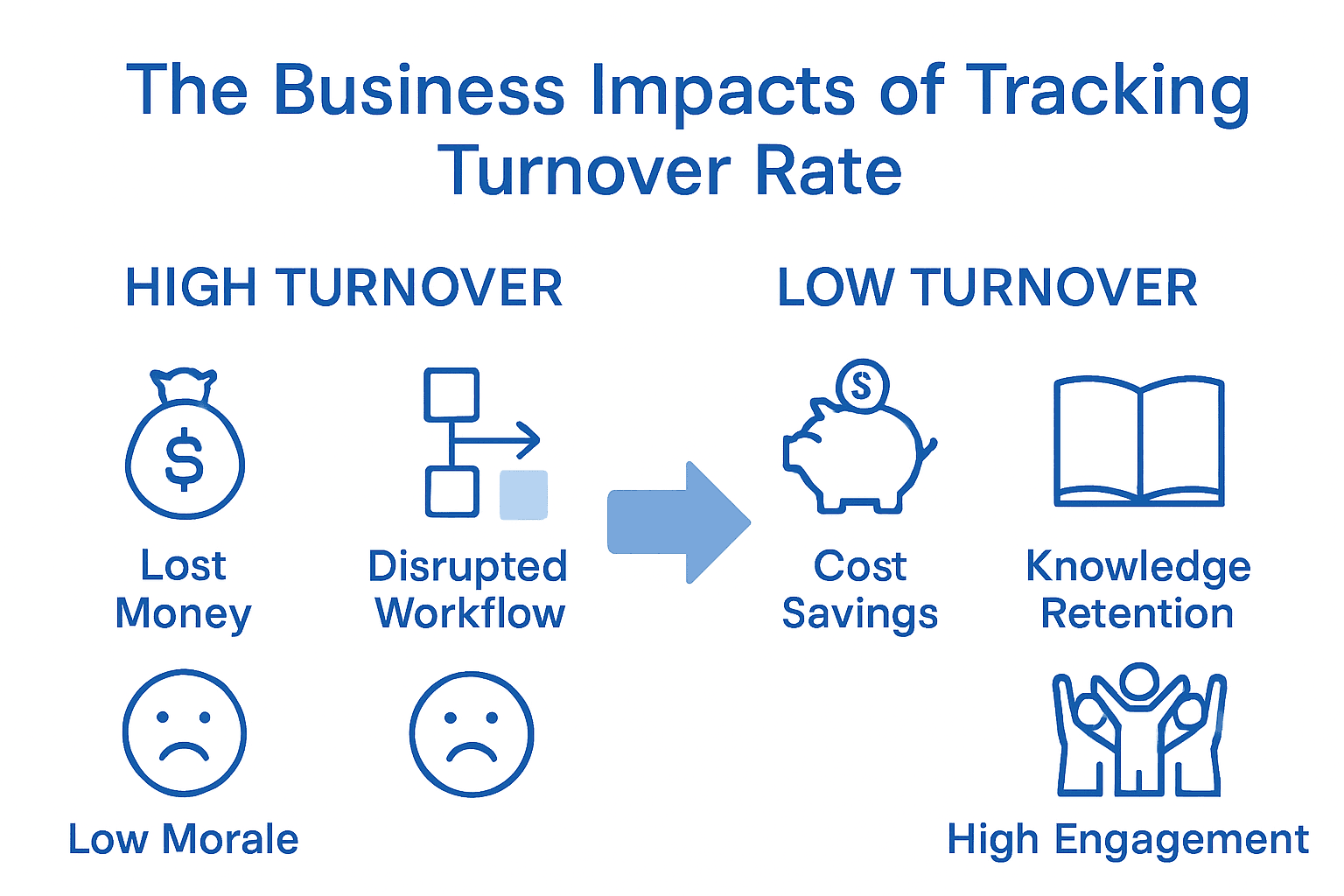
The economic impact of employee turnover extends beyond immediate replacement expenses. When an employee leaves, organizations face hidden costs including lost institutional knowledge, disrupted workflow, reduced team morale, and the extensive time required to recruit, hire, and train a replacement. Conservative estimates suggest replacement costs can range from 50% to 200% of an employee’s annual salary, depending on the role’s complexity and organizational level.
Strategic Workforce Perspective
Interestingly, SHRM offers a nuanced perspective, suggesting that turnover isn’t always negative. Strategic organizations can view workforce transitions as opportunities for organizational renewal, talent infusion, and cultural evolution. By tracking turnover patterns meticulously, businesses can:
- Identify systemic workplace challenges
- Benchmark performance against industry standards
- Develop targeted retention strategies
- Proactively manage workforce dynamics
Ultimately, sophisticated turnover tracking transforms raw data into a powerful strategic tool, enabling leaders to make informed decisions about talent management, organizational culture, and long-term business sustainability.
Actionable Strategies to Reduce High Turnover
Employee retention requires a multifaceted approach that addresses underlying workplace dynamics. Coursera emphasizes that effective strategies include enhancing management practices, offering job flexibility, and providing competitive compensation to create an environment where employees feel valued and motivated to stay.
Comprehensive Compensation and Benefits
Competitive compensation goes beyond base salary. Modern employees seek holistic compensation packages that include flexible work arrangements, professional development opportunities, comprehensive health benefits, and meaningful performance bonuses. Organizations must continually reassess their compensation strategies to remain attractive in a dynamic job market.
Workplace Culture and Engagement
According to Hospitality Insights, investing in comprehensive training programs and fostering a supportive work environment are critical for reducing turnover. Key strategies include:
- Implementing robust onboarding processes
- Creating clear career progression pathways
- Developing mentorship and coaching programs
- Encouraging open communication and feedback
- Recognizing and rewarding employee achievements
Successful retention is not about preventing all departures, but creating an organizational environment where employees choose to stay, grow, and contribute meaningfully. By implementing strategic, empathetic approaches to workforce management, companies can transform their turnover challenges into opportunities for organizational excellence.
Take Control of Your Employee Turnover Today
Understanding the true nature of your employee turnover rate is just the beginning. The challenge is pinpointing which employees are at risk of leaving and taking decisive steps to keep your top talent engaged and committed. This article highlights how voluntary and involuntary turnover affect your business along with common misconceptions that can hold you back from effective retention. If you want to transform turnover data into actionable strategies and reduce costly disruptions, you need a smart solution that works in real time.
Discover how OpenElevator uses a proprietary algorithm to identify employees likely to quit before it’s too late. Our platform provides customized retention tactics that help businesses from startups to Fortune 500 companies maintain a stable workforce, improve productivity, and save on recruiting expenses. Don’t wait for high turnover to impact your operations. Visit OpenElevator now to start securing your workforce and build a loyal team for the long term.
Frequently Asked Questions
What is the employee turnover rate?
The employee turnover rate is the percentage of workers who leave an organization, whether voluntarily or involuntarily, over a specific time period. It helps organizations assess their workforce stability and retention strategies.
How is the turnover rate calculated?
Turnover rate is calculated by dividing the total number of employee terminations by the average number of employees during a set period, typically a year, and then multiplying by 100 to get a percentage.
What are the common types of employee turnover?
The common types of employee turnover include voluntary turnover (employees choose to leave), involuntary turnover (employer-initiated terminations), functional turnover (departure of low performers), and dysfunctional turnover (loss of high performers).
Why is tracking turnover rate important for organizations?
Tracking the turnover rate is crucial as it provides insights into organizational health, helps identify potential retention challenges, assesses management effectiveness, and influences overall business performance and employee satisfaction.